It seems that 15 weeks is hardly enough preparation for a career that can span many, many years. That was a thought I had as I began General Methods in this the Fall 2010 semester at Mount Saint Mary College in Newburgh, NY. Little did I know the depth of instruction and quantity and quality of experiences that awaited me.
I am completely different than when I began. As a substitute teacher, I would hear the experienced teachers either joke or speak wistfully of their General Methods class and other college classes. They used terms that, although interesting, had no definitions in my mind. What struck me thought then was I really wanted to know what the terms meant. I really wanted to know how to teach.
I awaited General Methods eagerly because of an event that happened during one class period while I was substitute teaching. I had to teach a lesson on basic division. Okay, I thought to myself, I know how to divide and maybe even a few students could imagine the process. But I was completely at a loss as to how to get the concept across. I took a chance and drew a pizza on the board and started talking and dividing it into parts. I turned around and saw many blank stares. I was stuck. I couldn't impart the information that I knew I had in my head. I did give my self credit for trying but I had no tools to obtain from my toolbox whatsoever. If I only knew about assessing prior knowledge, about how to get their attention, how to even motivate them to group together and then separate (as in a social interactive lesson with its dual purpose of instructing on content) to illustrate division!
That event made me quite eager to learn the basic tools of our profession.
I can say now I have. I not only have learned them in an academic sense but had the opportunity to employ them in a safe, classroom (ours) environment before moving the skills out into the public by presenting them during the fieldwork. I saw good modeling (you did it), I got to do it and then I got to do it for real!
I will explore my experiences in fieldwork throughout this blog entry. I will say that I couldn't imagine the deficit that would be created if fieldwork was ever eliminated from the program.
The growth in my confidence as a teacher came through my fieldwork and only after I presented the three lesson plans for real. I had drafted lesson plans in other classes but this was the first time something I wrote was actually tried out. The academic lessons became real lessons. That was crucial for me. Wow. (Can you imagine how it feels to see a play that you wrote reach production?)
I was only somewhat surprised by how absolutely natural it felt for me to be in the front of the classroom (or walking around in it) as it did. In 2005, I wrote and instructed curriculum designed for 2-7 year olds in a youth group. The other day, I looked back at my notes and my full binders of lesson plans (my own creation) and realized I was assessing prior knowledge, I did have a "grabber", and I did do development and closure. I varied each session and mixed in group work and individual work. I did this for 3 years on my own. I had between 7-15 students per class. I sometimes had a parent volunteers but I generally ran the group alone.
Was that an omen? I hadn't yet decided to return to school but I had already ventured into that field, JOYOUSLY.
The greatest impression that I am taking away from this class as well as from the fieldwork experience is that some people are destined to become teachers. I see how my own children have reacted throughout the years to their teachers and the teachers I have had and those that I most remember. The profession of teaching is a holy one. We are duty bound to live by the values and the codes that we expect our students to live by. I have met teachers that have a deep and passionate glow in their eyes when they speak of teaching. There are some, also, that show no fire at all and would appear to have gone into teaching by mistake.
Another important impression was made by the group of fourth grade students who got to teach me about teaching in my fieldwork class. They took to me and hugged me. When I passed them in the hallways, they asked if I was coming to their class. I gathered from that that I made an impression on them. I know young children can be overly friendly and maybe they hug and request a visit from everyone but a part of me hopes it was because of me! I tried, while doing everything else that goes on during a lesson, to watch them. Just to observe their expressions and attentiveness levels. I am very expressive with my face and my hands so I think that they were attentive because of my animation as well as my words. Their faces told me so. There was only the typical amount of fidgeting and I really believed they respected me and what I was trying to accomplish with them.
I believe the students should know that you want them to feel a part of the lesson. Even though direct instruction requires the teacher to be doing most of the talking, you can still talk with the students and not just lecture at them. I liked the constant question and answer checking for understanding that I did even in the direct instruction lesson.
I have discovered, with the help of the graded rubrics from my cooperating teacher, that I need to eventually be able to not only teach the content but to be more aware of all the other behaviors going on alongside of the teaching part of a lesson. I know that comes with experience and practice. The comments from the teacher indicated that for her the noise level would have been too loud and the children too active during the direct instruction lesson. I have to say I didn't mind it and she acknowledged that it is completely a personal preference. I didn't notice it was getting loud because I was trying so hard to stay on my "script" for my lesson. I didn't criticise myself too much because I know I will learn how to do this facet of teaching as I get more experience.
All of the methods will work for me. The cooperative learning methods are my favorite because long after the students forget how to multiply fractions (I was studying for the NYSTCE CST-Multi-Subject today), they will have learned how to treat other people as partners in school and in life and how to discuss differences respectfully. I will try to incorporate social skill-building lessons often into my classroom. Elementary school is the ideal place to begin this type of teaching. The younger the better. Particularly if the school's population and behavioral issues indicate that there is little social skills training going on in the students' homes.
As I titled one of my blog posts, I have grown as a teacher because now I know I can do this. I can follow curriculum and create unique and intriguing lessons. One issue I foresee is my ability to really grasp the current learning levels of my students. But I think I feel this way because when I drafted my WebQuest, the level of skills needed did not align with the students that would be using it. I knew the class of 4th graders was basically one of struggling learners, although not inclusion or special education at all. The topic was from fourth grade but I think the skill level would have been more akin to 6th grade skills. We, the teacher and I, modified it as we went along. I also know that when I have my own class I will know where they are in their learning progress and be able to design lessons based on that knowledge.
I had the good fortune to be helped by so many teachers and administrators in my local school. They all welcomed me and offered me any assistance that I could ever need or want. They opened the school computer lab and the library to me. They even let me use the laminating machine for a culminating project of binding all of the posters form the cooperative learning lesson into a giant book. I couldn't have been more welcomed.
Personally what helps me most is my family's absolute devotion to my success. My children understand that when I have the door shut of my home-office that means that I am studying. When they had homework, they came to understand that I also had homework. Overall, my family has also learned a lesson about self-sacrifice (my time away from them) but also about self-importance (even though we are part of a family, we can all have our own interests).
I plan to use my unceasing stamina and patience to carry me successfully through my second career. As an elementary school teacher, I couldn't think of two personality traits that are more important.
I already explained my expectations of the class above with my story but I will add that I got so much more than I ever expected. The fieldwork is absolutely crucial and real professional growth comes from this opportunity to observe and work with a practicing teacher. I know that fieldwork is very difficult for some students to arrange but it really makes you do what you are waiting and learning how to do: teach. I really experienced a safe learning environment: one where I had time to learn, time to receive feedback, time to change my thoughts and work as appropriate, time to exchange ideas with the others in the class, time to actually execute my own ideas in a lesson plan of your own design. Wow.
In the Self-Evaluation Rubric, I addressed my thoughts on self-evaluation and peer review. In sum, self-evaluation is crucial to growth as a person and particularly as a teacher. You must know when to revise and "tweak" your obligations to your students. You can only know what to tweak if you are honest with yourself or have peer/colleague feedback.
When I began Nature of Schools in Summer II 2010 with absolutely limited knowledge of how to use the vast resources that the Internet held, I finished it feeling confident and experienced in using and sharing those resources. Just like in this class, I began the class with only the fear of teaching division in mind, yet as I finish this class, I not only have great set of filled binders of the real tools that a teacher needs, but I have solid experience in designing and executing appropriate lessons. And, the confidence to use them.
Thursday, December 2, 2010

Sunday, November 21, 2010
IPM: It is for EVERYONE
We left the Direct Instruction Strategy/Behavioral Model behind this month and delved into more unfamiliar content information.
We were asked to consider the question of "Why direct instruction is not enough?"
A very pertinent question that was initially hard for me to answer. I found that by then end of the month and after doing the readings and the in-class exercises, I could answer that question easily. Direct instruction is an excellent method of conveying BASIC information in its repetitive format but does nothing for the higher levels of thinking. Students must be able to not only absorb the facts of a concept, a strong foundation in the basics is crucial, but must also be able to apply, synthesize and evaluate the information into new and unique concepts. That is what the Information Processing Model and its corresponding methods of instruction generate among the students.
Simply put, DI is the foundation and IPM lessons are the tools to build the rest of the house!! Within an IPM lesson, students learn to ask questions about real-life problems, working teams to generate ideas about how to solve those problems, reach into their creativity on a variety of levels and think, not merely absorb.
(November content reflections)
Although DI teaches the basics, student don't have to carry around basic knowledge about concepts like they used to. In our information age, they can just look it up!!
But thinking skills, inquiry-based learning, must be taught now more than ever.
If our job as teachers is to educated our students, then we are duty-bound to teach them how to think so that they can one day educate themselves.
The IPM lesson do take longer to prepare and combined with the curriculum requirements might be impractical to use all of the time. It would be negligent of modern teachers to not incorporate IPM lessons periodically, even in small portions as an extension of a DI lesson.
There are countless methods with which to use the IPM. Certainly, after a bit of experimenting with some of them, teachers could find a method they are comfortable with and make a few lessons that incorporate it.
Ironically, since we missed a class on this topci, I found myself wishing for some Direct Instruction on the Information Processing Model!
We were asked to consider the question of "Why direct instruction is not enough?"
A very pertinent question that was initially hard for me to answer. I found that by then end of the month and after doing the readings and the in-class exercises, I could answer that question easily. Direct instruction is an excellent method of conveying BASIC information in its repetitive format but does nothing for the higher levels of thinking. Students must be able to not only absorb the facts of a concept, a strong foundation in the basics is crucial, but must also be able to apply, synthesize and evaluate the information into new and unique concepts. That is what the Information Processing Model and its corresponding methods of instruction generate among the students.
Simply put, DI is the foundation and IPM lessons are the tools to build the rest of the house!! Within an IPM lesson, students learn to ask questions about real-life problems, working teams to generate ideas about how to solve those problems, reach into their creativity on a variety of levels and think, not merely absorb.
(November content reflections)
Although DI teaches the basics, student don't have to carry around basic knowledge about concepts like they used to. In our information age, they can just look it up!!
But thinking skills, inquiry-based learning, must be taught now more than ever.
If our job as teachers is to educated our students, then we are duty-bound to teach them how to think so that they can one day educate themselves.
The IPM lesson do take longer to prepare and combined with the curriculum requirements might be impractical to use all of the time. It would be negligent of modern teachers to not incorporate IPM lessons periodically, even in small portions as an extension of a DI lesson.
There are countless methods with which to use the IPM. Certainly, after a bit of experimenting with some of them, teachers could find a method they are comfortable with and make a few lessons that incorporate it.
Ironically, since we missed a class on this topci, I found myself wishing for some Direct Instruction on the Information Processing Model!
Friday, November 5, 2010
I know I can do this now!
This is the response to the questions raised in the Jo 2 assignment for General Methods 5921-F10.
Although the lesson I gave on November 4, 2010 to a 4th grade class at the Sullivan West Elementary School was formulated around the Direct Instruction strategy and the Behavioral Model, my preparation for it rested in the pursuit of answers to many questions. In reality, my preparation required me to use the information processing model and the inductive teaching methods. I can explain.
Inductive teaching is based upon the claim that knowledge is built primarily upon the learner's experiences and interactions with phenomena. (From reading from Moodle, Week 10, Using Varied Instructional Techniques: Inductive and Deductive Teaching Approaches)I drew deeply on my prior experiences with children, as a mother, a substitute teacher and as someone who designed curriculum for a youth group for children ages 2-7 years old. I also frequently referred to all of the information I gained through the many weeks of classwork that we did on Direct Instruction to prepare an appropriate topic and grade-level lesson for this class.
Throughout the design/drafting process of the DI LP, I constantly asked myself questions about whether the grabber, development and activities were engaging and content-based. I constantly thought and rethought about what my objective was and if the lesson would meet that objective. I had an impression that the students I would be teaching were of the lower end of the "bell-shaped curve" of students and checked and rechecked my instructional levels of information. I questioned myself regularly about whether this group of students could absorb the information as I was presenting it. If I felt a particular activity (I ended up with six!) passed my scrutiny, I kept the activity as it was. If not, I redid it: changed the wording, changed the content a bit, and even changed the format of the activity itself. The writing and rewriting process required me to raise questions, make generalizations, and utilize the observations I made during the 4 hours of observation time that I spent with the class prior to designing the lesson.
In the Information Processing Model, the learners are presented with a problem, they are given the opportunity to investigate and find solutions to the problem, while developing their investigative skills and gaining confidence in their own abilities to think and to reflect on their progress. The problem for this assignment was to draft a DI LP lesson in camouflage. I dove into this lesson because animals are a personal passion of mine and how they share our world with us is also a passion. I readily and eagerly have learned about these topics since I was a child. Therefore, I already had vast experience with studying the animal kingdom. My investigative skills were honed when I went searching both the Curriculum Library and the Internet for resources to enhance my lesson plan. I gained confidence because I began to realize that I can solve this problem successfully because I found excellent information to help enhance my own ideas about how I wanted to lesson to be. I can also take advantage of the element requiring reflection before and after the lesson was presented.
I, in effect, gave myself an inquiry-based lesson while designing a direct instruction plan!
I can now tell you how the lesson went...
I arrived early which served me incredibly well because I was able to set up and greet the students at the door. I enjoyed the experience of being organized in that setting. In a certain way, I felt like I was some sort of specialist that came in to deliver a special lesson.
The children greeted me excitedly and sat right down in front of me as I directed them. I was seated in a chair at the front of the room. I definitely sensed their interest and curiosity as they came in.
My grabber was effective and actually grabbed them but did not over-excite or distract them. I believe the simplicity of the "funny nose and glasses" that I used as a disguise was an effective segue into a lesson on camouflage.
I planned many more activities than I actually had time for and that gave me confidence as well. The feeling of being prepared is incomparable! The confidence that that brings with it has always been and will always be a goal of mine.
I have evidence that the children learned because I constantly checked for understanding throughout the lesson and could tell from their responses during the activities that they understood the vocabulary that I had taught them during the development section. I have further evidence because I assigned them Independent Practice and they all did quite well.
During the vocabulary game, there was great enthusiasm. I was telling them the definitions to the vocabulary words and I purposely kept them general. But, impressively, they seized upon this loophole of vagueness. I was asking for just one word to go with the definition that I read out loud but they were responding with two or three words for the one word that I intended as the answer! Clever. They even protested when I told them I wouldn't accept certain other words for a certain definition. They were thinking critically about the subtleties of the meanings of the words I gave them. That was a completely unexpected but joyful occurrence.
The hard part was calming them back down after a point was scored by a team! I would do more with keeping their voice levels lower and keep them seated better. Students kept popping up out of their seats, in rapt excitement!
The overall experience was easy because I was so prepared and so excited. I felt naturally suited for this position.
I think that if the students in this and other classes, other teachers and peers would comment on my abilities, they would definitely say I had potential and great enthusiasm and friendliness. I have always prided myself in being approachable and intuitive about people and their needs. I know my students will learn that about me as well, someday. The information I am learning in MSMC and all of the outside reading and workshops that I am doing is greatly informing my abilities and generating great confidence for me.
The cooperating teachers I have worked with through the last year and one-half will have to say that I arrive prepared and organized and with a confident, friendly attitude towards my work and towards the students. These characteristics make it easy for the cooperating teachers to trust me with their students. I know that the teachers often feel a "loving possession" over their class. They sense I respect that feeling.
My knowledge of instruction and technology has already informed the teachers with whom I have had the occasion to discuss these items. The word WebQuest is now heard around the school! I have also told several teachers about PB Works and they have expressed interest in using it. I will be able to comment better after I present the students with my WebQuest in the next week or so.
The teacher commented today, November 5, 2010, as I met with her for her personal feedback that I am a very calm person, that the students, when she polled them, enjoyed the lesson and felt they had fun and learned a lot, and that I "seemed a natural in that place at the front of the room."
I have personal insight into myself as a teacher having finally taught I lesson that I prepared. I realize I can convey content information in a confident effective way. Even with this one example, I have an instant of proof that I can do this!!
Although the lesson I gave on November 4, 2010 to a 4th grade class at the Sullivan West Elementary School was formulated around the Direct Instruction strategy and the Behavioral Model, my preparation for it rested in the pursuit of answers to many questions. In reality, my preparation required me to use the information processing model and the inductive teaching methods. I can explain.
Inductive teaching is based upon the claim that knowledge is built primarily upon the learner's experiences and interactions with phenomena. (From reading from Moodle, Week 10, Using Varied Instructional Techniques: Inductive and Deductive Teaching Approaches)I drew deeply on my prior experiences with children, as a mother, a substitute teacher and as someone who designed curriculum for a youth group for children ages 2-7 years old. I also frequently referred to all of the information I gained through the many weeks of classwork that we did on Direct Instruction to prepare an appropriate topic and grade-level lesson for this class.
Throughout the design/drafting process of the DI LP, I constantly asked myself questions about whether the grabber, development and activities were engaging and content-based. I constantly thought and rethought about what my objective was and if the lesson would meet that objective. I had an impression that the students I would be teaching were of the lower end of the "bell-shaped curve" of students and checked and rechecked my instructional levels of information. I questioned myself regularly about whether this group of students could absorb the information as I was presenting it. If I felt a particular activity (I ended up with six!) passed my scrutiny, I kept the activity as it was. If not, I redid it: changed the wording, changed the content a bit, and even changed the format of the activity itself. The writing and rewriting process required me to raise questions, make generalizations, and utilize the observations I made during the 4 hours of observation time that I spent with the class prior to designing the lesson.
In the Information Processing Model, the learners are presented with a problem, they are given the opportunity to investigate and find solutions to the problem, while developing their investigative skills and gaining confidence in their own abilities to think and to reflect on their progress. The problem for this assignment was to draft a DI LP lesson in camouflage. I dove into this lesson because animals are a personal passion of mine and how they share our world with us is also a passion. I readily and eagerly have learned about these topics since I was a child. Therefore, I already had vast experience with studying the animal kingdom. My investigative skills were honed when I went searching both the Curriculum Library and the Internet for resources to enhance my lesson plan. I gained confidence because I began to realize that I can solve this problem successfully because I found excellent information to help enhance my own ideas about how I wanted to lesson to be. I can also take advantage of the element requiring reflection before and after the lesson was presented.
I, in effect, gave myself an inquiry-based lesson while designing a direct instruction plan!
I can now tell you how the lesson went...
I arrived early which served me incredibly well because I was able to set up and greet the students at the door. I enjoyed the experience of being organized in that setting. In a certain way, I felt like I was some sort of specialist that came in to deliver a special lesson.
The children greeted me excitedly and sat right down in front of me as I directed them. I was seated in a chair at the front of the room. I definitely sensed their interest and curiosity as they came in.
My grabber was effective and actually grabbed them but did not over-excite or distract them. I believe the simplicity of the "funny nose and glasses" that I used as a disguise was an effective segue into a lesson on camouflage.
I planned many more activities than I actually had time for and that gave me confidence as well. The feeling of being prepared is incomparable! The confidence that that brings with it has always been and will always be a goal of mine.
I have evidence that the children learned because I constantly checked for understanding throughout the lesson and could tell from their responses during the activities that they understood the vocabulary that I had taught them during the development section. I have further evidence because I assigned them Independent Practice and they all did quite well.
During the vocabulary game, there was great enthusiasm. I was telling them the definitions to the vocabulary words and I purposely kept them general. But, impressively, they seized upon this loophole of vagueness. I was asking for just one word to go with the definition that I read out loud but they were responding with two or three words for the one word that I intended as the answer! Clever. They even protested when I told them I wouldn't accept certain other words for a certain definition. They were thinking critically about the subtleties of the meanings of the words I gave them. That was a completely unexpected but joyful occurrence.
The hard part was calming them back down after a point was scored by a team! I would do more with keeping their voice levels lower and keep them seated better. Students kept popping up out of their seats, in rapt excitement!
The overall experience was easy because I was so prepared and so excited. I felt naturally suited for this position.
I think that if the students in this and other classes, other teachers and peers would comment on my abilities, they would definitely say I had potential and great enthusiasm and friendliness. I have always prided myself in being approachable and intuitive about people and their needs. I know my students will learn that about me as well, someday. The information I am learning in MSMC and all of the outside reading and workshops that I am doing is greatly informing my abilities and generating great confidence for me.
The cooperating teachers I have worked with through the last year and one-half will have to say that I arrive prepared and organized and with a confident, friendly attitude towards my work and towards the students. These characteristics make it easy for the cooperating teachers to trust me with their students. I know that the teachers often feel a "loving possession" over their class. They sense I respect that feeling.
My knowledge of instruction and technology has already informed the teachers with whom I have had the occasion to discuss these items. The word WebQuest is now heard around the school! I have also told several teachers about PB Works and they have expressed interest in using it. I will be able to comment better after I present the students with my WebQuest in the next week or so.
The teacher commented today, November 5, 2010, as I met with her for her personal feedback that I am a very calm person, that the students, when she polled them, enjoyed the lesson and felt they had fun and learned a lot, and that I "seemed a natural in that place at the front of the room."
I have personal insight into myself as a teacher having finally taught I lesson that I prepared. I realize I can convey content information in a confident effective way. Even with this one example, I have an instant of proof that I can do this!!
Have any quesitons? Go to a Museum!
For Week 9, Dr. Smirnova posted a video to watch. In light of my Internet service, videos always take longer to load than they are in viewing time! But, I proceeded.
Our topic was still Direct Instruction but with an eye towards beginning to learn about the Information Processing Model and Inquiry-based lesson plans. The video actually took place in the Long Island Children's Museum. The activities depicted were so vast and varied that I felt as though I had to go there with my own children as soon as possible. The perfect laboratory for learning!
The museum visit is an ideal combination of direct instruction and inquiry-based learning: the museum presenters had the children gather in small groups and gave them information and then encouraged them to touch, smell, think and question (asking questions of the museum presenters as well) on their own.
The forum of the museum presents opportunities for all sorts of learners to learn: visual, tactile, auditory, and inter- and intra-personal. The children's faces glowed with excitement and engagement. For the children on the field trip from their school, it could be that this is their only chance to experience such a place. For the children, young and older, visiting with their families, everyone had a chance to sit face-to-face, hear the information and then interact with each other with the information. Often times, families don't make time for this sort of essential educational and emotional interaction.
This adventure is constructivism at work!
Interestingly, the expressions of excitement on the children's faces at the beginning were still present at then end of the video but they also looked exhausted from their adventure!
I truly experienced their excitement with them during this video. I have gone to MANY museums myself and with my own children. As they play, they are learning. The educational process in a children's museum or in any hands-on exhibit occurs naturally. Knowledge is assembled naturally and remains with the children for a long, long time.
Our topic was still Direct Instruction but with an eye towards beginning to learn about the Information Processing Model and Inquiry-based lesson plans. The video actually took place in the Long Island Children's Museum. The activities depicted were so vast and varied that I felt as though I had to go there with my own children as soon as possible. The perfect laboratory for learning!
The museum visit is an ideal combination of direct instruction and inquiry-based learning: the museum presenters had the children gather in small groups and gave them information and then encouraged them to touch, smell, think and question (asking questions of the museum presenters as well) on their own.
The forum of the museum presents opportunities for all sorts of learners to learn: visual, tactile, auditory, and inter- and intra-personal. The children's faces glowed with excitement and engagement. For the children on the field trip from their school, it could be that this is their only chance to experience such a place. For the children, young and older, visiting with their families, everyone had a chance to sit face-to-face, hear the information and then interact with each other with the information. Often times, families don't make time for this sort of essential educational and emotional interaction.
This adventure is constructivism at work!
Interestingly, the expressions of excitement on the children's faces at the beginning were still present at then end of the video but they also looked exhausted from their adventure!
I truly experienced their excitement with them during this video. I have gone to MANY museums myself and with my own children. As they play, they are learning. The educational process in a children's museum or in any hands-on exhibit occurs naturally. Knowledge is assembled naturally and remains with the children for a long, long time.
Sunday, October 24, 2010
The case for getting rid of grades and stickers
I began a book called "Punished by Rewards" by Alfie Kohn. Published in 1993, Mr. Kohn stepped out of the prevailing theories of the time. He incises the management in the work place, teachers in education and parents at home and opens up their flagrant and faulty use of rewards as motivational tactics.
I was glued to this theory of abandoning rewards and grades and replacing extrinsic motivators with intrinsic ones. Mr. Kohn's claim is that when you use rewards to motivate employees, students or children, you become focused on the performance and not on the process of learning. The "if you do this then you get that" theory steals motivation from people and replaces it with a false focus on the "that."
All educators should read this book just for its opposing point of view to trends in the last many years.
The greatest question he asks is not "How can you get your students motivated?" but "How can you best create a learning environment where students don't feel controlled and in which they are encouraged to think about what they are doing?"
As I read the first chapters, and I have many more to go, I felt afraid of what the theory entailed as I believed in behaviorism. I have my doubts now as to its ability to generate atmospheres for true learning.
I'll keep you posted on my progress in the book and whether Mr. Kohn succeeded in he arguments and convinced me to follow his ideas.
I was glued to this theory of abandoning rewards and grades and replacing extrinsic motivators with intrinsic ones. Mr. Kohn's claim is that when you use rewards to motivate employees, students or children, you become focused on the performance and not on the process of learning. The "if you do this then you get that" theory steals motivation from people and replaces it with a false focus on the "that."
All educators should read this book just for its opposing point of view to trends in the last many years.
The greatest question he asks is not "How can you get your students motivated?" but "How can you best create a learning environment where students don't feel controlled and in which they are encouraged to think about what they are doing?"
As I read the first chapters, and I have many more to go, I felt afraid of what the theory entailed as I believed in behaviorism. I have my doubts now as to its ability to generate atmospheres for true learning.
I'll keep you posted on my progress in the book and whether Mr. Kohn succeeded in he arguments and convinced me to follow his ideas.
Eruption of Experience with the Volcano Lesson Plan
In class, we were all given a direct instruction lesson plan by Dr. Smirnova and asked to evaluate it in depth as against preassigned Mount Saint Mary College criteria.
The lesson plan I was assigned was on volcanoes and was designed for fourth grade.
I spent a long time reading each section and contemplating its content with the MSMC rubric for lesson plans next to the lesson plan on my desk.
The process was unique to me since I had only written my own lesson plans in Curriculum Planning and waited for their review by the professor. I had never had the opportunity to evaluate a lesson plan of someone else. Actually, I felt strange doing this and even emailed Dr. Smirnova about whom would have access to my comments. I was assured that the original author would not see my comments and that just Dr. Smirnova would. I felt way out of my league of experiences to think that I could, with only 9 classes under my belt, evaluate someone else's work. I thought, "Who am I do this?"
I continued however. I looked at a section of the lesson plan, looked through my notes and readings and even ventured onto the Internet for further clarification, and wound up back at the MSMC rubric. I picked apart every section. I enjoyed it to the extent that I felt I found an item of content that I thought was misplaced somehow. How it was misplaced, I couldn't have been sure. I did find issues that I was able to support with my understanding of what the lesson should have looked like by referring to my notes, etc.
I also learned several things from the content that I felt was appropriate. I really liked how the author mentioned the lessons that were coming next and connections made to similarities with prior lesson content. But, importantly, I realized that this author didn't check for understanding very much or at least did not spell out when he or she was going to do it.
Structurally, all parts of the typical DI lesson plan were met but I really found I could only reach "2's" on the rubric.
I could only hope that someone would spend as much time as I did on this review on one of my own lesson plans. I believe in learning by doing and learning from my mistakes. I would also like to know if I have the correct idea on the items that the reviewer felt I did correctly.
Overall, I appreciated the opportunity to compare and contrast: compare my ideas with those of someone else's about a direct instruction lesson and contrast what I believed to be correct content and style with content and style of another.
Read my next blog for some thoughts on an interesting book I am reading, "Punished by Rewards" by Alfie Kohn.
The lesson plan I was assigned was on volcanoes and was designed for fourth grade.
I spent a long time reading each section and contemplating its content with the MSMC rubric for lesson plans next to the lesson plan on my desk.
The process was unique to me since I had only written my own lesson plans in Curriculum Planning and waited for their review by the professor. I had never had the opportunity to evaluate a lesson plan of someone else. Actually, I felt strange doing this and even emailed Dr. Smirnova about whom would have access to my comments. I was assured that the original author would not see my comments and that just Dr. Smirnova would. I felt way out of my league of experiences to think that I could, with only 9 classes under my belt, evaluate someone else's work. I thought, "Who am I do this?"
I continued however. I looked at a section of the lesson plan, looked through my notes and readings and even ventured onto the Internet for further clarification, and wound up back at the MSMC rubric. I picked apart every section. I enjoyed it to the extent that I felt I found an item of content that I thought was misplaced somehow. How it was misplaced, I couldn't have been sure. I did find issues that I was able to support with my understanding of what the lesson should have looked like by referring to my notes, etc.
I also learned several things from the content that I felt was appropriate. I really liked how the author mentioned the lessons that were coming next and connections made to similarities with prior lesson content. But, importantly, I realized that this author didn't check for understanding very much or at least did not spell out when he or she was going to do it.
Structurally, all parts of the typical DI lesson plan were met but I really found I could only reach "2's" on the rubric.
I could only hope that someone would spend as much time as I did on this review on one of my own lesson plans. I believe in learning by doing and learning from my mistakes. I would also like to know if I have the correct idea on the items that the reviewer felt I did correctly.
Overall, I appreciated the opportunity to compare and contrast: compare my ideas with those of someone else's about a direct instruction lesson and contrast what I believed to be correct content and style with content and style of another.
Read my next blog for some thoughts on an interesting book I am reading, "Punished by Rewards" by Alfie Kohn.
Monday, October 18, 2010
Direct Instruction Lesson Plan Reflection
I drafted my first DI LP, MSMC style. I appreciate the thorough preparation I am receiving here. The plan was 10 pages long. I thought of many angles and wrote out my lesson "script." That works for me. Even if I don't say the words exactly as written, I certainly have a solid idea of where I am heading and where I want to end up with the lesson.
This practice is excellent. I am excited to actually deliver a lesson that I am writing. I took Literacy in the Content Areas and I gave a one hour lesson to one student each week but we did not have to write them up in the official MSMC format. We focused on the student's interests and brought in books and activities the coincided.
This lesson plan is for a large class of #21 students. I believe my lesson plan is a good one. But what do I know!
Good night now.
This practice is excellent. I am excited to actually deliver a lesson that I am writing. I took Literacy in the Content Areas and I gave a one hour lesson to one student each week but we did not have to write them up in the official MSMC format. We focused on the student's interests and brought in books and activities the coincided.
This lesson plan is for a large class of #21 students. I believe my lesson plan is a good one. But what do I know!
Good night now.
Tuesday, October 5, 2010
Addendum to Week 6- I learned an important skill
I believe in order to learn how to teach, you must first learn how to learn. In order for any learning to occur, the learner has to open his or her mind to receiving information in many forms. The opening T-shirt project required me to distill very crucial parts of my life and my career into 4 representative images. That was tough to do but I accomplished it by focusing on doing it. The WebQuest will prove to be a similar experience: the task being assigned must be completed but the journey will be a unique experience for each person. Group presentations require us to use skills that some of us don't use often or easily: communication and collaboration skills but which are CRUCIAL in the professional world of teaching. These tasks are giving us a controlled environment within which to experiment with our own strengths and weaknesses and develop all of them. Our class, this last month, has given me and my classmates an opportunity to learn with guidance and then learn independently awaiting feedback. The module has made me enlightened the direct instruction strategy in a very complete way. Despite the cliche, my eyes have been opened with the terminology and procedures relating to direct instruction.
I have realized some professional growth as well. While I substitute teach, I find that I default to using direct instruction methods. I did that in past years but I never knew what it was called; I just did it naturally. I say "default" because I am in no way prepared to move the students out of the direct instruction format as a substitute teacher. I have been a better substitute teacher now that I am familiar with this strategy. Once I learn the other strategies, I will be able to try to use those as well, even while substitute teaching.
I have realized some professional growth as well. While I substitute teach, I find that I default to using direct instruction methods. I did that in past years but I never knew what it was called; I just did it naturally. I say "default" because I am in no way prepared to move the students out of the direct instruction format as a substitute teacher. I have been a better substitute teacher now that I am familiar with this strategy. Once I learn the other strategies, I will be able to try to use those as well, even while substitute teaching.
I have learned a very important skill- Direct Instruction
Week 6- This entry is a recap of my learning outcomes from September 2010 or from the first 5-6 weeks of General Methods of Instruction.
This module provided a very varied approach to the application of the Direct Instruction (DI) strategy, allowed me to revise my assumptions about DI, and added a crucial skill to my skill repertoire.
I had the opportunity to learn about Direct Instruction in many ways. I was introduced to the topic by Dr. Smirmova, I read many articles about the topic and watched actual examples of DI in use via various video clips, I was a member of a group and prepared a presentation of part of the lesson plan structure of a DI lesson, I observed five other groups give their presentations on parts of this topic, I reviewed and critiqued an actual DI lesson (on volcanoes), I reflected on my presentation, and now am reflecting on the entire module.
The overall atmosphere in our classroom is one of collaboration and support. This atmosphere allows me to be comfortable volunteering information and receiving corrections when that information is not completely accurate. I believe that we all learn from making errors and getting immediate feedback.
I considered this module the crumbling of preconceived notions about Direct Instruction. I only envisioned DI as a lecture and in my recollections of my own education, the lectures were typically long, boring and seemingly inapplicable to my life. After completing the readings and the diverse exposure to the topic, I genuinely know I was wrong in my earlier beliefs. DI must also be as engaging as any other form of instruction and must be even more carefully planned than some because of its purpose: to lay strong foundational knowledge on a topic upon which to build future learning. Checking for student understanding and ensuring that the foundational knowledge is secure is absolutely essential before moving ahead to higher level thinking on the current topic or on future related topics.
Although the readings did not discuss the correlation to the educational standards, whether national or statewide, it is obvious that a carefully designed DI lesson would have to first go to the standards to determine the topics to be taught and how to teach them. I always refer first to the standards, as a former lawyer, applying standards (or applying statutes as the case used to be) is the logical place to begin to make sure that their requirements are foremost in the lesson plan.
As I become more facile with the steps needed to build a DI lesson, the brief temptation occurred to me that that a lesson template could be designed, a formulaic approach. As I thought this thought through, however, I decided that although the steps of each DI lesson must be the same, the content should always be suitably revised to precisely meet the learning objectives.
I am a strong visual learner and so I found this is a terrific diagram of the steps that make up a Direct Instruction lesson plan:
http://www.worksheetlibrary.com/teachingtips/imagedirectgif.gif.
The conceptual framework was carefully laid out in the last several weeks of class and related module work. I refer to having learned about DI in such detail as having added a crucial tool to my teacher toolbox. We haven't covered the other instructional strategies in detail yet but I am comfortable in knowing how to recognize when and how to use the DI strategy. (Much like a golfer must know which club to use for whatever shot s/he wants to make!)
This video link to a teacher discussing the details of direct instruction was exceptionally helpful in explaining this process. That link is: http://www.youtube.com/watch?v=Fr3ccG6vmqg.
Since I have had such an intense introduction and several opportunities to have guided and independent practice, I feel so confident in this topic that I will also endeavor today to begin writing my own DI lesson as part of the course's requirements. I am eagerly waiting to begin applying all of this knowledge and experience to my own initial DI lesson plan and then to the many DI lessons that are ahead of me as I begin to teach.
This module provided a very varied approach to the application of the Direct Instruction (DI) strategy, allowed me to revise my assumptions about DI, and added a crucial skill to my skill repertoire.
I had the opportunity to learn about Direct Instruction in many ways. I was introduced to the topic by Dr. Smirmova, I read many articles about the topic and watched actual examples of DI in use via various video clips, I was a member of a group and prepared a presentation of part of the lesson plan structure of a DI lesson, I observed five other groups give their presentations on parts of this topic, I reviewed and critiqued an actual DI lesson (on volcanoes), I reflected on my presentation, and now am reflecting on the entire module.
The overall atmosphere in our classroom is one of collaboration and support. This atmosphere allows me to be comfortable volunteering information and receiving corrections when that information is not completely accurate. I believe that we all learn from making errors and getting immediate feedback.
I considered this module the crumbling of preconceived notions about Direct Instruction. I only envisioned DI as a lecture and in my recollections of my own education, the lectures were typically long, boring and seemingly inapplicable to my life. After completing the readings and the diverse exposure to the topic, I genuinely know I was wrong in my earlier beliefs. DI must also be as engaging as any other form of instruction and must be even more carefully planned than some because of its purpose: to lay strong foundational knowledge on a topic upon which to build future learning. Checking for student understanding and ensuring that the foundational knowledge is secure is absolutely essential before moving ahead to higher level thinking on the current topic or on future related topics.
Although the readings did not discuss the correlation to the educational standards, whether national or statewide, it is obvious that a carefully designed DI lesson would have to first go to the standards to determine the topics to be taught and how to teach them. I always refer first to the standards, as a former lawyer, applying standards (or applying statutes as the case used to be) is the logical place to begin to make sure that their requirements are foremost in the lesson plan.
As I become more facile with the steps needed to build a DI lesson, the brief temptation occurred to me that that a lesson template could be designed, a formulaic approach. As I thought this thought through, however, I decided that although the steps of each DI lesson must be the same, the content should always be suitably revised to precisely meet the learning objectives.
I am a strong visual learner and so I found this is a terrific diagram of the steps that make up a Direct Instruction lesson plan:
http://www.worksheetlibrary.com/teachingtips/imagedirectgif.gif.
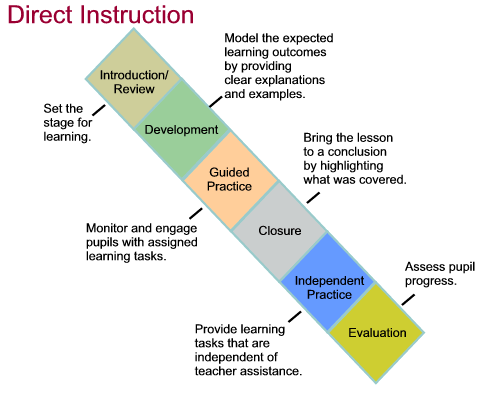
The conceptual framework was carefully laid out in the last several weeks of class and related module work. I refer to having learned about DI in such detail as having added a crucial tool to my teacher toolbox. We haven't covered the other instructional strategies in detail yet but I am comfortable in knowing how to recognize when and how to use the DI strategy. (Much like a golfer must know which club to use for whatever shot s/he wants to make!)
This video link to a teacher discussing the details of direct instruction was exceptionally helpful in explaining this process. That link is: http://www.youtube.com/watch?v=Fr3ccG6vmqg.
Since I have had such an intense introduction and several opportunities to have guided and independent practice, I feel so confident in this topic that I will also endeavor today to begin writing my own DI lesson as part of the course's requirements. I am eagerly waiting to begin applying all of this knowledge and experience to my own initial DI lesson plan and then to the many DI lessons that are ahead of me as I begin to teach.
Thursday, September 30, 2010
Dr. George Sugai- An opportunity to hear an expert speak
On September 28, 2010, I attended a conference where Dr. George Sugai, nationally and internationally known expert in the field of PBIS, was the keynote speaker.
His warm, gently, positive personality filled the room and put a very diverse group of learners (new and experienced teacher, BOCES representatives, PBIS teams, guidance counselors, school social workers and school psychologists), administrators, and a parent (me) all at ease.
His words and slides from his PPT had us all scratching on our papers taking notes as rapidly as the ink would flow, so as not to miss one syllable of his presentation.
He frequently referred to the Response-to-Intervention triangle and the triangle of logic. These are references as the variety of needs that students have. The largest percentage of students (80%) deserve PBIS benefits as do the top 5% or the students with the most need for interventions.
He made implementing PBIS seem as necessary as serving school lunches to the health of a school's community. There were light breezes through the room of skepticism but most often there were gusts of approval and agreement for his words.
He made it seem immediately doable. He emphasized, though, the absolute need for parent involvement in implementing PBIS in its most effective manner.
I felt honored to be among such a group, a 10-year veteran parent but not yet an official teacher. I felt welcomed and respected by the other attendees that I met and felt part of a grassroots-type of group. I learned that some districts have had PBIS in place for 9-10 years with great success. The representatives of schools with younger programs envied their successes even though they were experiencing their own successes, albeit slowly.
The afternoon ended with a workshop in district groups to evaluate their need to implement PBIS or their need to improve or ramp up the PBIS programming already in place. My kids' home district is in its 3rd year of PBIS with very positive results in the reduction of office referrals.
This is an exciting philosophy to be a part of and with the extensive research available providing a solid evidence base, conclusions are being made that PBIS is as important in all grade levels as any other instruction that goes on. In fact, PBIS allows teachers to reclaim more instructional time than they even realize. A statistical analysis was even given by Dr. Sugai suggesting how many hudreds of instructional hours teachers can reclaim for instructional time when disciplinary issues are effectively controlled.
I could just go on about this but my fingers are tired of typing.
Here is the web address for the national PBIS site: www.pbis.org You need to check this out!
Wendy
His warm, gently, positive personality filled the room and put a very diverse group of learners (new and experienced teacher, BOCES representatives, PBIS teams, guidance counselors, school social workers and school psychologists), administrators, and a parent (me) all at ease.
His words and slides from his PPT had us all scratching on our papers taking notes as rapidly as the ink would flow, so as not to miss one syllable of his presentation.
He frequently referred to the Response-to-Intervention triangle and the triangle of logic. These are references as the variety of needs that students have. The largest percentage of students (80%) deserve PBIS benefits as do the top 5% or the students with the most need for interventions.
He made implementing PBIS seem as necessary as serving school lunches to the health of a school's community. There were light breezes through the room of skepticism but most often there were gusts of approval and agreement for his words.
He made it seem immediately doable. He emphasized, though, the absolute need for parent involvement in implementing PBIS in its most effective manner.
I felt honored to be among such a group, a 10-year veteran parent but not yet an official teacher. I felt welcomed and respected by the other attendees that I met and felt part of a grassroots-type of group. I learned that some districts have had PBIS in place for 9-10 years with great success. The representatives of schools with younger programs envied their successes even though they were experiencing their own successes, albeit slowly.
The afternoon ended with a workshop in district groups to evaluate their need to implement PBIS or their need to improve or ramp up the PBIS programming already in place. My kids' home district is in its 3rd year of PBIS with very positive results in the reduction of office referrals.
This is an exciting philosophy to be a part of and with the extensive research available providing a solid evidence base, conclusions are being made that PBIS is as important in all grade levels as any other instruction that goes on. In fact, PBIS allows teachers to reclaim more instructional time than they even realize. A statistical analysis was even given by Dr. Sugai suggesting how many hudreds of instructional hours teachers can reclaim for instructional time when disciplinary issues are effectively controlled.
I could just go on about this but my fingers are tired of typing.
Here is the web address for the national PBIS site: www.pbis.org You need to check this out!
Wendy
Week 5 General Methods
We are deep into learning about direct instruction and all of its methods of presentation. In 6 groups we all presented a micro-teaching on each element of a DI lesson.
The elements of a DI lesson are:
the anticipatory set (hook, pre-assess knowledge, advanced organizer to inform students as to what is coming next);
the development section which can include explanations, demonstrations, and modeling or some or all of those methods;
checking for understanding to occur frequently throughout the lesson to ensure that the students are all understanding the concepts being taught and if some are not, the teacher will readjust the pace or re-teach;
guided practice- once the information is conveyed by the teacher (I do it) then it is the "we do it" segment where students work on the learning the information with the teacher's constant supervision, assistance, and checking for understanding;
then the teacher does drill and practice exercises with the students to ultimately get the information into the students' long-term memories (again with more checking for understanding);
then the students apply what they have learned on their own under the "you do it" segment, typically without the teacher's assistance at all and at the students' own pace;
the last elements are closure and reflection- the teacher and/or the students sum up what was covered during the lesson and connects it back to what they knew before the lesson and what the lesson is going to lead to next;
teacher and student reflections are important ways to correct and improve the lesson for the future or to comment on what went well about the lesson.
Very intense but very exciting information.
Wendy
The elements of a DI lesson are:
the anticipatory set (hook, pre-assess knowledge, advanced organizer to inform students as to what is coming next);
the development section which can include explanations, demonstrations, and modeling or some or all of those methods;
checking for understanding to occur frequently throughout the lesson to ensure that the students are all understanding the concepts being taught and if some are not, the teacher will readjust the pace or re-teach;
guided practice- once the information is conveyed by the teacher (I do it) then it is the "we do it" segment where students work on the learning the information with the teacher's constant supervision, assistance, and checking for understanding;
then the teacher does drill and practice exercises with the students to ultimately get the information into the students' long-term memories (again with more checking for understanding);
then the students apply what they have learned on their own under the "you do it" segment, typically without the teacher's assistance at all and at the students' own pace;
the last elements are closure and reflection- the teacher and/or the students sum up what was covered during the lesson and connects it back to what they knew before the lesson and what the lesson is going to lead to next;
teacher and student reflections are important ways to correct and improve the lesson for the future or to comment on what went well about the lesson.
Very intense but very exciting information.
Wendy
Reflection on Drill & Practice presentation 9-29-10
Group 4- PPT on Drill and Practice Method of Direct Instruction
Here is my reflection on our presentation:
Three cheers to my group! Thank you all and I had a lot of fun putting this together with all of you.
1. I felt we were all very prepared and we, in fact, collaborated very successfully with Google Docs.
2. We all made good eye contact, voice projection and used the slides as guides and did not read from them too much. I personally read from the slides at times but only to make sure (with the aim, goal and objective) that I had the precise wording correct.
3. I thought our hook was engaging but then I realized that after we had the audience's attention I did not pre-assess knowledge right away (although I did after the advanced organizer- maybe the advanced organizer should've been after pre-assessment of knowledge?) nor did I repeatedly check for understanding. I see that as an error in the presentation.
4. We could've used the available technology more to enhance our presentation. Sadly, the only links we included did not work at the time despite the links working during our practice session.
5. I truly enjoyed working with Sally, Pam and Kelly. I knew that once we broke up the tasks, the tasks would be completely very well. And they were.
6. We also didn't really deliver the information in small, memorable chunks. I think all these skills develop with practice. Putting this presentation together made me aware of what skills are necessary to proficiently use drill and practice!
7. I did announce the aim, goal and objective to the class where I should have just realized that the learning opportunity activity would address those parts of the lesson naturally.
8. I agree with Sally that we should've presented the class with a summative assessment exercise to check for understanding.
9. I also used "will be able to" in my goal and objective. I now understand why that is not appropriate. I understand that there must be an observable or measurable element to the goal and objective.
Taking this time to reflect is a very important way for me to improve my skills.
Wendy
Here is my reflection on our presentation:
Three cheers to my group! Thank you all and I had a lot of fun putting this together with all of you.
1. I felt we were all very prepared and we, in fact, collaborated very successfully with Google Docs.
2. We all made good eye contact, voice projection and used the slides as guides and did not read from them too much. I personally read from the slides at times but only to make sure (with the aim, goal and objective) that I had the precise wording correct.
3. I thought our hook was engaging but then I realized that after we had the audience's attention I did not pre-assess knowledge right away (although I did after the advanced organizer- maybe the advanced organizer should've been after pre-assessment of knowledge?) nor did I repeatedly check for understanding. I see that as an error in the presentation.
4. We could've used the available technology more to enhance our presentation. Sadly, the only links we included did not work at the time despite the links working during our practice session.
5. I truly enjoyed working with Sally, Pam and Kelly. I knew that once we broke up the tasks, the tasks would be completely very well. And they were.
6. We also didn't really deliver the information in small, memorable chunks. I think all these skills develop with practice. Putting this presentation together made me aware of what skills are necessary to proficiently use drill and practice!
7. I did announce the aim, goal and objective to the class where I should have just realized that the learning opportunity activity would address those parts of the lesson naturally.
8. I agree with Sally that we should've presented the class with a summative assessment exercise to check for understanding.
9. I also used "will be able to" in my goal and objective. I now understand why that is not appropriate. I understand that there must be an observable or measurable element to the goal and objective.
Taking this time to reflect is a very important way for me to improve my skills.
Wendy
Monday, September 27, 2010
Week 4 General Methods
This week we really dove into the exploration of the behavioral model/direct instruction strategy. We read about B.F. Skinner's operant conditioning and Watson's classical conditioning of behaviors. Skinner believed that the consequences of an action determined the behavior and the frequency at which such behaviors occurred. I really believe in his theory. PBIS is an extension of his work. Dr. George Sugai is the modern leader popularizing the use of PBIS (Positive Behavioral Interventions and Supports) in schools.
From my speech on Sept. 14, I was invited to attend an all-day PBIS workshop in which Dr. Sugai is the keynote speaker. That is for Tues., Sept. 28 at our famed Bethel Woods Center for the Arts in Bethel, NY. I am excited and feel very privileged to be included.
Back to the behavioral model...
We were asked to fill in a direct instruction graphic organizer. A find exercise for someone like me who can rarely summarize anything!! I did it though. I liked doing it also! I think my lack of abilities in summarization comes from my lack of confidence in my memory. I have a very weak memory. I can visualize information in its sequence if I arrange it that way. The graphic organizer is so helpful for that purpose.
The most important item I realized is that direct instruction need not be boring. It needs to be structured and efficient for its purpose of teaching basic information for students to absorb into their long-term memories, but it need not be solely in lecture format!
And, after watching some short videos on direct instruction in action, I have come to believe in its effectiveness for these purposes.
I find when I substitute teach, I tend to use DI a lot because I had no other options. Unless the teacher leaves plans regarding learning center time or other pre-planned activities allowing other indirect methods, I don't want to veer off into too much unfamiliar territory.
As our class weeks progress, I will know more about the other strategies and could try to redesign the class lessons to incorporate other strategies than DI.
On to the next week...
Wendy
From my speech on Sept. 14, I was invited to attend an all-day PBIS workshop in which Dr. Sugai is the keynote speaker. That is for Tues., Sept. 28 at our famed Bethel Woods Center for the Arts in Bethel, NY. I am excited and feel very privileged to be included.
Back to the behavioral model...
We were asked to fill in a direct instruction graphic organizer. A find exercise for someone like me who can rarely summarize anything!! I did it though. I liked doing it also! I think my lack of abilities in summarization comes from my lack of confidence in my memory. I have a very weak memory. I can visualize information in its sequence if I arrange it that way. The graphic organizer is so helpful for that purpose.
The most important item I realized is that direct instruction need not be boring. It needs to be structured and efficient for its purpose of teaching basic information for students to absorb into their long-term memories, but it need not be solely in lecture format!
And, after watching some short videos on direct instruction in action, I have come to believe in its effectiveness for these purposes.
I find when I substitute teach, I tend to use DI a lot because I had no other options. Unless the teacher leaves plans regarding learning center time or other pre-planned activities allowing other indirect methods, I don't want to veer off into too much unfamiliar territory.
As our class weeks progress, I will know more about the other strategies and could try to redesign the class lessons to incorporate other strategies than DI.
On to the next week...
Wendy
Week 3 General Methods
I am a little behind on my blogs for right now.
Week 3 was 9/13-9/19 and was an overview of lesson planning and its structures and models of instruction.
I was having trouble keeping the terminology straight: what is a model? a method? a strategy?
But I understand now.
The best image is an inverted triagle with four divisions. The broadest segment is the models. A model is only one of four instructional practices: behavioral, information processing, social interaction, and personal.
A slightly more narrow section represents the instructional strategies: which are either two or five categories. For the 2: direct or indirect, with 4 strategies being included under the heading of indirect. For the 5: direct, indirect, interactive, experimental (process not product), and independent study.
An even more narrow category represents the instructional methods, the actual manner in which instructional environments are created. There are many of these and they are found under each instructional strategy. Our readings had very explicit and comprehensive diagrams that were very helpful in learning these distinctions.
Finally, the most narrow category are the skills being taught. These are the most specific instructional behaviors.
We also had the opportunity to practice writing learning objectives. These are tricky to draft in a logical way so that they can actually be implemented. We have the MSMC model that is very helpful. I keep that model on my desk and refer to it often. Drill and Practice- an instructional method under DI!
All of these categories are related and all of them serve different instructional purposes.
Since direct instruction is the most commonly used strategy, we will spend the next two-three weeks on learning and practicing how to employ DI.
This was a good review!
Wendy
Week 3 was 9/13-9/19 and was an overview of lesson planning and its structures and models of instruction.
I was having trouble keeping the terminology straight: what is a model? a method? a strategy?
But I understand now.
The best image is an inverted triagle with four divisions. The broadest segment is the models. A model is only one of four instructional practices: behavioral, information processing, social interaction, and personal.
A slightly more narrow section represents the instructional strategies: which are either two or five categories. For the 2: direct or indirect, with 4 strategies being included under the heading of indirect. For the 5: direct, indirect, interactive, experimental (process not product), and independent study.
An even more narrow category represents the instructional methods, the actual manner in which instructional environments are created. There are many of these and they are found under each instructional strategy. Our readings had very explicit and comprehensive diagrams that were very helpful in learning these distinctions.
Finally, the most narrow category are the skills being taught. These are the most specific instructional behaviors.
We also had the opportunity to practice writing learning objectives. These are tricky to draft in a logical way so that they can actually be implemented. We have the MSMC model that is very helpful. I keep that model on my desk and refer to it often. Drill and Practice- an instructional method under DI!
All of these categories are related and all of them serve different instructional purposes.
Since direct instruction is the most commonly used strategy, we will spend the next two-three weeks on learning and practicing how to employ DI.
This was a good review!
Wendy
Monday, September 20, 2010
Authentic Work 9-14-10
On September 14, 2010, I presented a 7-minute speech at my children's elementary school at the "Meet-The-Teacher" Night Open House on a topic that I had prepared for the Educational Change project for Nature of Schools with Dr. Smirnova that I took during the Summer II semester at Mount Saint Mary College in Newburgh, NY.
The project's hypothesis was that if schools are already presenting their students with the Positive Behavioral Intervention and Supports program, then parents should pick up on this and adopt its principles at home. I theorized that this would make an even more powerful connection between home and school and would necessarily have a significant effect on the reduction of disciplinary issues that occur at school and thereby create more time for learning.
In July 2010, to fulfil this project's requirements, I approached our elementary school vice-principal with this hypothesis. She was thrilled to announce that the school was putting into place just such a program for the 2010-2011 school year! At about the same moment that I was going to volunteer to help in implementing that program whether on my own as a parent or via the school's PTSO, the vice-principal asked me if I would give a speech, albeit a brief one, at the upcoming Open House. Needless to say, with nervous excitement, I agreed to speak. She was particularly comfortable with me doing this because she knew from prior conversations, from prior academic projects, and from knowing my own two children, that I already practiced these philosophies at home. I am also a familiar face to many parents since I have been very involved at the school since my son started Kindergarten in 2005.
I drafted the potential speech and then met with the VP once to go over the ideas contained within it. She read it and approved of the content and said that the presentation style would be up to me. I chose a speech context, podium and microphone, but I rehearsed it so that I could just speak to the parents rather than read the speech.
Before I spoke that evening, a very dedicated woman from our local school bus company spoke on the PBIS topic. I didn't know she would be there and I found it hard to follow her. She was so complete in her information about how to use the PBIS the children were already learning at school to connect with what expectations there were of them on the bus and even at home. But, nonetheless, I was introduced by the VP, and advised the parents that I only had 7 minutes more of their time. I sensed that they were anxious to go meet their children's teachers, so I even edited the speech as I delivered it.
I anxiously watched the crowd as I spoke for spontaneous reactions to presenting them with this "new" idea of "catching their children being good" rather than always giving them attention when they were misbehaving. I saw some "eye rolls" but I saw some deep nods of approval and interest as well. I made sure that the speech pointed out that the children will make this easy for the parents to do at home because they already were involved in the program 8 hours per day at school.
At the close, I did receive applause, but I will never know if that was due to my ideas or due to their relief that the speaking was over and they could move onto their children's classrooms!
My goal was to reach just one person with this idea of acknowledging a child's positive behaviors. If one child was spared the degrading, self-esteem depleting comments that so many parents so easily and thoughtlessly pile onto their children of any age, my efforts will have been successful.
I believe today's schools must embrace the philosophies of community building through creating a positive learning environment and that parents must also embrace these ideas at home to bring about the consistency that children require for healthy maturation. After all, parents and teachers must share the same goal of raising children into adults that will be productive members of society, however we define productive.
In conclusion, I learned that believing in something very strongly gives you endless energy to be involved in "it." I learned that I can possibly teach adults as well as children. I learned that there is absolutely NO substitute for planning ahead and for being prepared. Preparation leads to confidence. I learned that I can be a credible advocate for an idea. I learned that I can write and deliver an actual speech and not just an extemporaneous discussion that I am usually comfortable with.
I turned a project for class that was largely going to remain hypothetical into a platform for
opening people's minds. I had the opportunity to make this project authentic. I learned the value of that authentic connection and truly realized its necessity with lesson planning as well.
Wendy S.
PS- As a footnote, today, Sept. 20, 2010, I learned of possibly that one person whose mind I opened. I went into our school today and the VP showed me a paper towel she had found in the cafeteria the day after the Open House. The note was in pen and was about three sentences telling a child how proud that this mom was of the great start to this school year the child was having and how the child should keep up the good work.
I was proud of that mom and proud to have possibly been the one that presented her with this idea.
The project's hypothesis was that if schools are already presenting their students with the Positive Behavioral Intervention and Supports program, then parents should pick up on this and adopt its principles at home. I theorized that this would make an even more powerful connection between home and school and would necessarily have a significant effect on the reduction of disciplinary issues that occur at school and thereby create more time for learning.
In July 2010, to fulfil this project's requirements, I approached our elementary school vice-principal with this hypothesis. She was thrilled to announce that the school was putting into place just such a program for the 2010-2011 school year! At about the same moment that I was going to volunteer to help in implementing that program whether on my own as a parent or via the school's PTSO, the vice-principal asked me if I would give a speech, albeit a brief one, at the upcoming Open House. Needless to say, with nervous excitement, I agreed to speak. She was particularly comfortable with me doing this because she knew from prior conversations, from prior academic projects, and from knowing my own two children, that I already practiced these philosophies at home. I am also a familiar face to many parents since I have been very involved at the school since my son started Kindergarten in 2005.
I drafted the potential speech and then met with the VP once to go over the ideas contained within it. She read it and approved of the content and said that the presentation style would be up to me. I chose a speech context, podium and microphone, but I rehearsed it so that I could just speak to the parents rather than read the speech.
Before I spoke that evening, a very dedicated woman from our local school bus company spoke on the PBIS topic. I didn't know she would be there and I found it hard to follow her. She was so complete in her information about how to use the PBIS the children were already learning at school to connect with what expectations there were of them on the bus and even at home. But, nonetheless, I was introduced by the VP, and advised the parents that I only had 7 minutes more of their time. I sensed that they were anxious to go meet their children's teachers, so I even edited the speech as I delivered it.
I anxiously watched the crowd as I spoke for spontaneous reactions to presenting them with this "new" idea of "catching their children being good" rather than always giving them attention when they were misbehaving. I saw some "eye rolls" but I saw some deep nods of approval and interest as well. I made sure that the speech pointed out that the children will make this easy for the parents to do at home because they already were involved in the program 8 hours per day at school.
At the close, I did receive applause, but I will never know if that was due to my ideas or due to their relief that the speaking was over and they could move onto their children's classrooms!
My goal was to reach just one person with this idea of acknowledging a child's positive behaviors. If one child was spared the degrading, self-esteem depleting comments that so many parents so easily and thoughtlessly pile onto their children of any age, my efforts will have been successful.
I believe today's schools must embrace the philosophies of community building through creating a positive learning environment and that parents must also embrace these ideas at home to bring about the consistency that children require for healthy maturation. After all, parents and teachers must share the same goal of raising children into adults that will be productive members of society, however we define productive.
In conclusion, I learned that believing in something very strongly gives you endless energy to be involved in "it." I learned that I can possibly teach adults as well as children. I learned that there is absolutely NO substitute for planning ahead and for being prepared. Preparation leads to confidence. I learned that I can be a credible advocate for an idea. I learned that I can write and deliver an actual speech and not just an extemporaneous discussion that I am usually comfortable with.
I turned a project for class that was largely going to remain hypothetical into a platform for
opening people's minds. I had the opportunity to make this project authentic. I learned the value of that authentic connection and truly realized its necessity with lesson planning as well.
Wendy S.
PS- As a footnote, today, Sept. 20, 2010, I learned of possibly that one person whose mind I opened. I went into our school today and the VP showed me a paper towel she had found in the cafeteria the day after the Open House. The note was in pen and was about three sentences telling a child how proud that this mom was of the great start to this school year the child was having and how the child should keep up the good work.
I was proud of that mom and proud to have possibly been the one that presented her with this idea.
Saturday, September 11, 2010
New Semester- General Methods
September 11, 2010
This is a tough day in America and around the world. I feel compelled to mention this as an American and a future educator.
We, as teachers, must be charged with using our position to make our students realize that it is more broadening to focus on similarities and respect our differences than to fear our differences. This fear, and then loathing, is what built up in those criminals that destroyed so many lives 9 years ago today.
I take very seriously my own obligation to teach my own children that we are all of one species and whatever the "outside covering" is, the insides: the values, the heart and the soul, are not so different from culture to culture. Sting sang in the 1980's about "If the Russians loved their children too..." Anyone recall that song?
For Week 1:
With that said, the video "Learning to Change" deftly points out and explains where we are as a nation in terms of our education processes. Apparently, our philosophies need updating. I learned last semester about how our educational system was modeled after the Industrial Revolution's practices of uniform, assembly line philosophies. NO more is that applicable, in fact, it is a dangerous proposition to maintain. We need to raise and educate THINKERS not robots. It is an exciting time to be a teacher. The one commentator said that students have a more enriching life educationally out of school than in school. That has got to change or at least become equal to the stimulation outside of school.
For Week 2:
A-G-O
The difference between Aims, Goals and Objectives are their purposes. Aims are very broad statements of educational principles that a district hopes to achieve. Goals are slightly more specific and indicate the intention to achieve an educational level without yet saying how it will be reached. An objective is finite and based on observable and measurable behaviors: the student will know exactly how he or she is to achieve the requested level.
The sources for formulating aims, goals and objective are many. The A-G-O can be designed based on national and state standards, district-wide standards, building-wide standards, educational opportunity grant requirements, a teacher’s personal designs on his or her methods of instruction, specific curriculum to bring certain information to the students. Referencing Bloom’s Taxonomy is essential when designing A-G-O to ensure that students are reaching to higher levels of thinking during the lessons.
I was intrigued by the theories of "deep" and "surface" learning. I find that I use both forms myself. When I work for class or to prepare for some other activities, I put all of my motivation into what I am doing. But, when I read the newspaper, I typically am scanning for items that interest me and just don't remember the rest of what I have "read."
Students should be given the right to use both methods as well. Some educational tasks require surface learning, ie: memorization, before deep learning can occur. However, we as teachers, must seek to design lessons that require the students involvement and therefore, try to avoid "surface" learning and stimulate "deep" learning. Also, teachers must keep in mind that students represent various kinds of learners and must seek to accommodate those varieties of information processing styles. Learing includes: comprehending and applying information as well as simply being able to recognize information and then go from there to learn more.
Week 2- Methods, Strategies, Methods:
I would like to hear responses to whether you all feel good about learning the specifc tools of our trade? Models are the toolbox, stategies, methods and skills are the details.
I am finally learning the tools of teaching. I really understand my obligation as a teacher but now I am learning HOW to teach the content- the techniques. The word "technique" is often trivialized as sort of a gimmick. From Week 2's reading, that is hardly the case for teachers. Just as a photographer uses various lenses to capture certain images, we, as teachers, have many tools to use as well.
I envision a model as a gigantic umbrella under which strategies, methods and skills come to rest. Or, as an inverted triangle, with models on top, at the widest point, and funneling downward towards skills.
I had curricular planning last fall and I anticipate learning in this class how I could make the lessons of my unit plan even better. A carpenter wouldn't use a drill when she needed a hammer. A teacher shouldn't use direct instruction when the lesson is calling for experiential learning.
Models, strategies and methods must necessarily align with assessment methods. In order to see if the students are absorbing and learning the information being given in whatever fashion it is being given, the teacher must have an assessment method in which the students can accurately and adequately convey what they know/learned. Rubrics are my favorite. They allow for the teacher to prepare the students for the assessment by explaining all that will be expected of them to complete the assessment. Up front, purposeful, self-determining. Authentic assessments- harder to evaluate maybe, but will allow our students to exist in replicas of the real world in which they exist. Despite my favor for authentic assessments, traditional ones do have their place in limited ways. It is difficult to conceive of traditional assessments as being anything but snap-shot statements of a student's skills. Most people can meet expectations set out for them, however, they must be allowed to meet them at their own pace. The absolute opposite possibility when traditional (forced-choice) assessments are in volved. I agree that some traditional testing must be used before moving onto to an authentic assessment just to make sure that the knowledge required for the auth. assess. is there.
The chauffeur example from the reading is an ideal one: I'd rather have the chauffeur who passed the driving portion and not the written if I had to choose!
I often feel like I am ready to get right into the classroom as authentic work, rather than read about teaching!
WHEW!!
Wendy S.
This is a tough day in America and around the world. I feel compelled to mention this as an American and a future educator.
We, as teachers, must be charged with using our position to make our students realize that it is more broadening to focus on similarities and respect our differences than to fear our differences. This fear, and then loathing, is what built up in those criminals that destroyed so many lives 9 years ago today.
I take very seriously my own obligation to teach my own children that we are all of one species and whatever the "outside covering" is, the insides: the values, the heart and the soul, are not so different from culture to culture. Sting sang in the 1980's about "If the Russians loved their children too..." Anyone recall that song?
For Week 1:
With that said, the video "Learning to Change" deftly points out and explains where we are as a nation in terms of our education processes. Apparently, our philosophies need updating. I learned last semester about how our educational system was modeled after the Industrial Revolution's practices of uniform, assembly line philosophies. NO more is that applicable, in fact, it is a dangerous proposition to maintain. We need to raise and educate THINKERS not robots. It is an exciting time to be a teacher. The one commentator said that students have a more enriching life educationally out of school than in school. That has got to change or at least become equal to the stimulation outside of school.
For Week 2:
A-G-O
The difference between Aims, Goals and Objectives are their purposes. Aims are very broad statements of educational principles that a district hopes to achieve. Goals are slightly more specific and indicate the intention to achieve an educational level without yet saying how it will be reached. An objective is finite and based on observable and measurable behaviors: the student will know exactly how he or she is to achieve the requested level.
The sources for formulating aims, goals and objective are many. The A-G-O can be designed based on national and state standards, district-wide standards, building-wide standards, educational opportunity grant requirements, a teacher’s personal designs on his or her methods of instruction, specific curriculum to bring certain information to the students. Referencing Bloom’s Taxonomy is essential when designing A-G-O to ensure that students are reaching to higher levels of thinking during the lessons.
I was intrigued by the theories of "deep" and "surface" learning. I find that I use both forms myself. When I work for class or to prepare for some other activities, I put all of my motivation into what I am doing. But, when I read the newspaper, I typically am scanning for items that interest me and just don't remember the rest of what I have "read."
Students should be given the right to use both methods as well. Some educational tasks require surface learning, ie: memorization, before deep learning can occur. However, we as teachers, must seek to design lessons that require the students involvement and therefore, try to avoid "surface" learning and stimulate "deep" learning. Also, teachers must keep in mind that students represent various kinds of learners and must seek to accommodate those varieties of information processing styles. Learing includes: comprehending and applying information as well as simply being able to recognize information and then go from there to learn more.
Week 2- Methods, Strategies, Methods:
I would like to hear responses to whether you all feel good about learning the specifc tools of our trade? Models are the toolbox, stategies, methods and skills are the details.
I am finally learning the tools of teaching. I really understand my obligation as a teacher but now I am learning HOW to teach the content- the techniques. The word "technique" is often trivialized as sort of a gimmick. From Week 2's reading, that is hardly the case for teachers. Just as a photographer uses various lenses to capture certain images, we, as teachers, have many tools to use as well.
I envision a model as a gigantic umbrella under which strategies, methods and skills come to rest. Or, as an inverted triangle, with models on top, at the widest point, and funneling downward towards skills.
I had curricular planning last fall and I anticipate learning in this class how I could make the lessons of my unit plan even better. A carpenter wouldn't use a drill when she needed a hammer. A teacher shouldn't use direct instruction when the lesson is calling for experiential learning.
Models, strategies and methods must necessarily align with assessment methods. In order to see if the students are absorbing and learning the information being given in whatever fashion it is being given, the teacher must have an assessment method in which the students can accurately and adequately convey what they know/learned. Rubrics are my favorite. They allow for the teacher to prepare the students for the assessment by explaining all that will be expected of them to complete the assessment. Up front, purposeful, self-determining. Authentic assessments- harder to evaluate maybe, but will allow our students to exist in replicas of the real world in which they exist. Despite my favor for authentic assessments, traditional ones do have their place in limited ways. It is difficult to conceive of traditional assessments as being anything but snap-shot statements of a student's skills. Most people can meet expectations set out for them, however, they must be allowed to meet them at their own pace. The absolute opposite possibility when traditional (forced-choice) assessments are in volved. I agree that some traditional testing must be used before moving onto to an authentic assessment just to make sure that the knowledge required for the auth. assess. is there.
The chauffeur example from the reading is an ideal one: I'd rather have the chauffeur who passed the driving portion and not the written if I had to choose!
I often feel like I am ready to get right into the classroom as authentic work, rather than read about teaching!
WHEW!!
Wendy S.
Monday, July 26, 2010
Group 5/Week 5- Finding the way to the future...
July 26, 2010
Group 3/Week 5: Wendy Schwalb & Pat Alfarone
We spoke at length about the numbered topics. Here are our notes.
Our opinion is that there is work to do but we are ready to do it!
1. The future in terms of the effect on human lives and the shape that schooling and education are likely to take.
Home school- access to public school extracurricular because of paying taxes. Good use of paying taxes.
Focus is interest-based.
Virtual teacher- used by home-schooling families.
Adjunct to the current system? Like Skype.
Depending upon the location.
Joint statement: Future will see more use of school choices.
When the future choice has a greater benefit that the current choice, the change will occur. (Like when the change is more like from the horse-and-buggy to the automobile) But, who will go the way of the buggy whip manufacturers? They will adapt or go extinct. Cost benefit analysis.
2. Characteristics of a teacher in the new informational era and the role of
the process of professional career development.
Motivate from love of something or from fear of something.
Teacher's char. should be no different in the future than they are now: enthusiasm, life-long learner, and be able to impart that to others. Some people should not teach just like some people should not be mechanics or doctors or any other career. Teachers choose their profession as others choose their professions.
Learned practical things from class- end result of teaching!! Learning.
3. Predict the development of Education and Schooling in the future.
Development: trying to align with current job market from the early ages.
Microsoft co. set up. Gossiping vs. Collaboration! Think tank. Getting work done!
Linear vs. global style of instruction. Down with podiums! Social vs. intellectual levels. Logical combination of ages. But, if the lower level students are always with that level... Differentiated instruction? RTI. Puts intervention on teachers.
4. How much does students' education and school's effectiveness depend on teacher? The entire education process of one student is a group enterprise. So many facets. Education comes from home also. Improve individual, improves the overall educational environment. PBIS!! Teaching people how to be responsible and how to respect themselves. This must start at home. Build values into everything.
Group 3/Week 5: Wendy Schwalb & Pat Alfarone
We spoke at length about the numbered topics. Here are our notes.
Our opinion is that there is work to do but we are ready to do it!
1. The future in terms of the effect on human lives and the shape that schooling and education are likely to take.
Home school- access to public school extracurricular because of paying taxes. Good use of paying taxes.
Focus is interest-based.
Virtual teacher- used by home-schooling families.
Adjunct to the current system? Like Skype.
Depending upon the location.
Joint statement: Future will see more use of school choices.
When the future choice has a greater benefit that the current choice, the change will occur. (Like when the change is more like from the horse-and-buggy to the automobile) But, who will go the way of the buggy whip manufacturers? They will adapt or go extinct. Cost benefit analysis.
2. Characteristics of a teacher in the new informational era and the role of
the process of professional career development.
Motivate from love of something or from fear of something.
Teacher's char. should be no different in the future than they are now: enthusiasm, life-long learner, and be able to impart that to others. Some people should not teach just like some people should not be mechanics or doctors or any other career. Teachers choose their profession as others choose their professions.
Learned practical things from class- end result of teaching!! Learning.
3. Predict the development of Education and Schooling in the future.
Development: trying to align with current job market from the early ages.
Microsoft co. set up. Gossiping vs. Collaboration! Think tank. Getting work done!
Linear vs. global style of instruction. Down with podiums! Social vs. intellectual levels. Logical combination of ages. But, if the lower level students are always with that level... Differentiated instruction? RTI. Puts intervention on teachers.
4. How much does students' education and school's effectiveness depend on teacher? The entire education process of one student is a group enterprise. So many facets. Education comes from home also. Improve individual, improves the overall educational environment. PBIS!! Teaching people how to be responsible and how to respect themselves. This must start at home. Build values into everything.
Sir Ken Robinson-Paradigm Shift
I was supposed to add this to my final reflection post but I just read this assignment.
That video that was assigned for Week 1 and now again for Week 5 made a great impact on me. In Week 1, the world of an online class was a mystery to me as I sat with my headset on watching a Youtube video. Now I look back and realize how far I have come. I have quoted Sir Ken Robinson to my teacher friends, when he said, We must transform not reform. Wow. I then thought about butterflies. Nothing changes more than a butterfly in its lifetime. Teachers must be willing and able to not only adapt to change but to effect it. He indicated a global crisis in human resources. He sites the increase in education spending has not altered academic outcomes in most cases. He asks "Why?" His bottom line is that no one, no government nor school board is daring to change the underlying system of purveying education in America. The digital immigrants are trying to teach the digital natives. It could work but why not try to engage the students in the forum in which they are already engaged: technology. We must, as teachers, espouse and encourage divergent thinking in our students. We systematically dumb our children down and pigeon-hole them in tracts of learning. I want to be a part of something more than that. I intend to create a classroom where standards can be met alongside of creativity. Where creativity doesn't somehow equate to a lacking in accountability. Why did that impression arise? How can we let go of the need for standardization (assembly line) learning? Why must there be NATIONAL standards? Every town has its own pros and cons, why can't students' learning reflect their local values but with an eye on being able to function in the larger world? I guess I would agree to national standards if the federal government offered more than 10% of the total for educational spending. The states should be left to make standards that apply to their own student population. The work I have done with applying state and national standards was effectively guided my preparation of lesson plans not hindered it. I think that standards are confused with preparation for standardized tests. I think standardized tests are the bane of public education. The preparation for which eliminates teachers' ability to teach for 3 of 10 months depending on the grade level. And the cost and what do the numbers really show?? Have the students give presentations to state ed. officials to show their knowledge not take a snapshot of one unpredictable day of testing.
Sir Ken Robinson has it right: Transform not reform (to alter what already exists).
Wendy S.
That video that was assigned for Week 1 and now again for Week 5 made a great impact on me. In Week 1, the world of an online class was a mystery to me as I sat with my headset on watching a Youtube video. Now I look back and realize how far I have come. I have quoted Sir Ken Robinson to my teacher friends, when he said, We must transform not reform. Wow. I then thought about butterflies. Nothing changes more than a butterfly in its lifetime. Teachers must be willing and able to not only adapt to change but to effect it. He indicated a global crisis in human resources. He sites the increase in education spending has not altered academic outcomes in most cases. He asks "Why?" His bottom line is that no one, no government nor school board is daring to change the underlying system of purveying education in America. The digital immigrants are trying to teach the digital natives. It could work but why not try to engage the students in the forum in which they are already engaged: technology. We must, as teachers, espouse and encourage divergent thinking in our students. We systematically dumb our children down and pigeon-hole them in tracts of learning. I want to be a part of something more than that. I intend to create a classroom where standards can be met alongside of creativity. Where creativity doesn't somehow equate to a lacking in accountability. Why did that impression arise? How can we let go of the need for standardization (assembly line) learning? Why must there be NATIONAL standards? Every town has its own pros and cons, why can't students' learning reflect their local values but with an eye on being able to function in the larger world? I guess I would agree to national standards if the federal government offered more than 10% of the total for educational spending. The states should be left to make standards that apply to their own student population. The work I have done with applying state and national standards was effectively guided my preparation of lesson plans not hindered it. I think that standards are confused with preparation for standardized tests. I think standardized tests are the bane of public education. The preparation for which eliminates teachers' ability to teach for 3 of 10 months depending on the grade level. And the cost and what do the numbers really show?? Have the students give presentations to state ed. officials to show their knowledge not take a snapshot of one unpredictable day of testing.
Sir Ken Robinson has it right: Transform not reform (to alter what already exists).
Wendy S.
ED 5210-T1 Nature of Schools Final Reflective Blog
I was just typing for 20 minutes about this entry and received a message that my typing could not be posted nor saved. Ahhhh.... technology. Now, it is telling me it is autosaving my entry. Thanks, Blogger.com.
Here goes take 2...
My professor in Measurements and Assessments spent the last 10 minutes of an intense 10-hour per week, 3.5 week class, going over the learning objectives that she believed we needed to cover during the class. That was an experience I had never had in all of my many, many years of schooling. Those 10 minutes gave me such a sense of accomplishment in that coursework, as much as any other assessment that she gave us. We so rarely give ourselves that precious moment of reflection to truly absorb information or an experience. She gave us that as she read the objectives and then stopped and asked if we all felt as though it were met. We nodded or agreed verbally and then she went on to the next one. It was truly meditative for me. I function well with lists and checking off items as I complete them but this process not only allowed me to put a check in the box it also allowed me to consider my experience in the coursework and see if I had truly absorbed the material and was thence ready to apply it to my own students. I did feel that I was able to apply the skills and information in the future as I would need to.
Reflective time is crucial but so often shoved aside with any action that we undertake.
I am glad to again have the opportunity to reflect upon the learning outcomes of this class. I will go through and present my reflections on learning objectives from this syllabus.
Objectives #1 & #2: I learned about the parallel of American public education to an Industrial Revolution-era assembly line. That was revolutionary for its time but that time has come for that to change. Linear learning just doesn't fit today's model of the globally interconnected society that we live in. Teachers must be at the forefront of that restructurings. I learned that, through the readings and review of the video clips and my own investigatory tangents, that teachers can lead this charge for change! I am more informed now about the history of the American educational system so now I can determine how to change the future. I would like to see slightly longer school days and more parental involvement. Those two factors seem to account for great success in the schools that have it. Schools around the world all do things differently and I believe we could adapt some of the methods that other schools employ around the world. Particularly, the opportunity for instruction on Saturdays if needed and shorter but more frequent vacations to avoid the intense review periods necessary after a long vacation.
Objectives #3 & #4: To know how to approach students, you must know yourself. The educational philosophy quiz confirmed a lot of what I already believed about myself and my teaching style. I hope I can sustain it once I am in the actual classroom. The Connectivism Theory was an outstanding reading that made me believe that my philosophies will bring me success as a teacher. I believe that we are all connected. My discussion topic of the Butterfly Effect for Week 2 confirms this. I learned that I have to be aware of all of the moral, social, religious, and secular issues that go on around me and that will go on around and effect everything about my students. It is hard not to feel overwhelmed by this responsibility. I just know I will adapt and blossom in this career. The foundations of education come from people and people are part of a society of many believes and characteristics. I will search for a way to blend these characteristics and show understanding and appreciation for those who possess them. The readings on Behaviorism, Cognitivism, and Constructionism all provided me with insights into why people behave the way they do and how I can use these theories in my classroom to adjust behavior issues and encourage educational growth. A calm classroom does not necessarily indicate a sterile, boring classroom. A constructive atmosphere indicates learning at a student's own pace and following his or her own interests. I learned that I will feel comfortable offering many learning options to my students so long as they can demonstrate their knowledge and application of the content, the form will be given much leeway. I so appreciated the opportunity to learn about emotional intelligence. It is important that awareness of this facet of students is growing. It is as much a component of learning as the academic side of it.
Objective #5: I have so met this objective. I have come so far in my technological experiences with this class. Personally, I have come light years! I have designed my own Website and Blog, I have worked on a Wiki (loved it!), on WiZiQ, an online collaborative site (tough and frustrating but doable), LetterPop was impossible to download photos onto, explored an online text book, etc.
I learned that I needed to learn these sites for myself before I could ever hope to teach my own students about technological applications. It is sort of egotistical for me to believe I could teach my students much about technology anyway! I learned that technology has and will continue to have an incredibly forceful effect on public education. The schools must transform into global learning workshops. Linear is OUT! Self-directed, interest-based instruction and learning models must be in. Factual regurgitation is out, who needs it when information is a click away. Critical-thinking and the ability to assemble and present knowledge is where teachers must direct their students. The video clips were overwhelming AND exciting. The student were asking me to "Engage Them"! Wow. I can do this. I also know where and how to get help to become current. I easily give myself over to learning. I am not afraid to learn myself and will impart that to my students about their own learning, with and without technology. I enjoyed the video clips of the scientists and researchers studying the effects of technology on teenagers and their world of instant communication and their desire to collaborate. That is excellent news for me. That gives me hope that long before me wanting to become a teacher, that there have been teachers at the forefront of teaching with technology. The Internet is a miracle! I can live and work in a rural area thanks to the Internet. I am ready to teach with technology by my side and cannot wait for the group of teachers that will arrive in the future that are digital natives! What will their fears be?
Objective #6: I had always wondered about the difference between magnet and charter schools. I also wondered how they were financed. I learned so much about these terms and their application during Week 3 and the readings and discussions that I have with my partner. I can intelligently speak on any of the school options as well as on the ramifications of each for the public school systems. I am grateful for my understanding of these topics because they are so pertinent and so current. I was interested to read about the rise of the school choice movement. That gives me hope that there are MANY parents who place a high value on the education of their children. I am not sure where my light cynicism is coming from though. Perhaps it is baseless. But for parents to gather and form groups to demand access to school choice is exciting and encouraging to me. I do worry about the ways that parents decide to pursue other schooling options. Is it out of anger and frustration in a reactive way or is it mostly in a proactive way. Do parents get appropriate information? Are the foundations of their requests based in academic issues or safety issues? Can you make correct decisions if you are angry? Who should be in charge of giving parents the information? Are school choice issues race-based issues? Regarding schooling in other nations, there was little reading on that topic that I saw. There were some broken links though. I did do a presentation recently in my collaboration class where I studied body language of other nations. Just as some nations have very formal body language signals, I can somewhat imply that some nations are very formal about who is educated and who is not, mostly males are privileged with obtaining an education in many countries. Sexism is rampant in many countries regarding education. I am familiar with Greg Mortenson's Three Cups of Tea and Stones into Schools. Both are non-fiction accounts of education in Pakistan and Afghanistan respectively. Very different from here in levels of access. However, in the remotest villages discussed in both books, the desire to have educated children was very strong. There were so many obstacles that the peoples' resolve was even greater. Highly recommended reading for teachers-to-be and teachers that are already teaching.
Objectives #7 & #8: I have come to believe in my last year of study and probably from my experiences with my children in a Montessori pre-school, that a teacher's role is as a facilitator for learning. Lecturing from a pulpit must now be reserved for other parts of a child's day and not in school. Learning must be authentic and hands-on. Applicable to their real life and not hypothetical. Teachers must have the personality to convey their own enthusiasm for learning. I know I can do that. I stop to explore the contents of a puddle or to determine what kind of spider is in a certain web. I have ALWAYS been like that. My personality compels me to experience the sheer joy of learning something new and then finding someone to share that new knowledge with. I have done more analysis of things that I am learning here than I had in a long time. The rigors of school are always good for awakening the brain after it gets into a daily routine of doing chores, etc. I must beware of becoming a permanent student!
I have learned to inquire of myself, to inquire of experts, of colleagues, of classmates, of my own teachers, with confidence in knowing that is how I will learn.
My choice for my educational change project is an example of my perspective on learning. I want to open parents minds to the need for connection with their children's school and its educators. The parents are the foundation of the children's behaviors and personalities and attitudes. I believe that if parents hear the perspective of another parent that they know and trust that they will at least consider the idea of using PBIS principles at home.
I have learned so many unquantifiable things from this class experience. I feel modernized and invigorated. I felt downtrodden and lost also at times. Frustrated often with the technologies limitations and my own learning curve. I have learned what it is to be a modern student.
I will take these new perspectives with me into my own classroom someday. I will be aware of the needs of all of my students by becoming aware of my own needs and abilities as a student.
Here goes take 2...
My professor in Measurements and Assessments spent the last 10 minutes of an intense 10-hour per week, 3.5 week class, going over the learning objectives that she believed we needed to cover during the class. That was an experience I had never had in all of my many, many years of schooling. Those 10 minutes gave me such a sense of accomplishment in that coursework, as much as any other assessment that she gave us. We so rarely give ourselves that precious moment of reflection to truly absorb information or an experience. She gave us that as she read the objectives and then stopped and asked if we all felt as though it were met. We nodded or agreed verbally and then she went on to the next one. It was truly meditative for me. I function well with lists and checking off items as I complete them but this process not only allowed me to put a check in the box it also allowed me to consider my experience in the coursework and see if I had truly absorbed the material and was thence ready to apply it to my own students. I did feel that I was able to apply the skills and information in the future as I would need to.
Reflective time is crucial but so often shoved aside with any action that we undertake.
I am glad to again have the opportunity to reflect upon the learning outcomes of this class. I will go through and present my reflections on learning objectives from this syllabus.
Objectives #1 & #2: I learned about the parallel of American public education to an Industrial Revolution-era assembly line. That was revolutionary for its time but that time has come for that to change. Linear learning just doesn't fit today's model of the globally interconnected society that we live in. Teachers must be at the forefront of that restructurings. I learned that, through the readings and review of the video clips and my own investigatory tangents, that teachers can lead this charge for change! I am more informed now about the history of the American educational system so now I can determine how to change the future. I would like to see slightly longer school days and more parental involvement. Those two factors seem to account for great success in the schools that have it. Schools around the world all do things differently and I believe we could adapt some of the methods that other schools employ around the world. Particularly, the opportunity for instruction on Saturdays if needed and shorter but more frequent vacations to avoid the intense review periods necessary after a long vacation.
Objectives #3 & #4: To know how to approach students, you must know yourself. The educational philosophy quiz confirmed a lot of what I already believed about myself and my teaching style. I hope I can sustain it once I am in the actual classroom. The Connectivism Theory was an outstanding reading that made me believe that my philosophies will bring me success as a teacher. I believe that we are all connected. My discussion topic of the Butterfly Effect for Week 2 confirms this. I learned that I have to be aware of all of the moral, social, religious, and secular issues that go on around me and that will go on around and effect everything about my students. It is hard not to feel overwhelmed by this responsibility. I just know I will adapt and blossom in this career. The foundations of education come from people and people are part of a society of many believes and characteristics. I will search for a way to blend these characteristics and show understanding and appreciation for those who possess them. The readings on Behaviorism, Cognitivism, and Constructionism all provided me with insights into why people behave the way they do and how I can use these theories in my classroom to adjust behavior issues and encourage educational growth. A calm classroom does not necessarily indicate a sterile, boring classroom. A constructive atmosphere indicates learning at a student's own pace and following his or her own interests. I learned that I will feel comfortable offering many learning options to my students so long as they can demonstrate their knowledge and application of the content, the form will be given much leeway. I so appreciated the opportunity to learn about emotional intelligence. It is important that awareness of this facet of students is growing. It is as much a component of learning as the academic side of it.
Objective #5: I have so met this objective. I have come so far in my technological experiences with this class. Personally, I have come light years! I have designed my own Website and Blog, I have worked on a Wiki (loved it!), on WiZiQ, an online collaborative site (tough and frustrating but doable), LetterPop was impossible to download photos onto, explored an online text book, etc.
I learned that I needed to learn these sites for myself before I could ever hope to teach my own students about technological applications. It is sort of egotistical for me to believe I could teach my students much about technology anyway! I learned that technology has and will continue to have an incredibly forceful effect on public education. The schools must transform into global learning workshops. Linear is OUT! Self-directed, interest-based instruction and learning models must be in. Factual regurgitation is out, who needs it when information is a click away. Critical-thinking and the ability to assemble and present knowledge is where teachers must direct their students. The video clips were overwhelming AND exciting. The student were asking me to "Engage Them"! Wow. I can do this. I also know where and how to get help to become current. I easily give myself over to learning. I am not afraid to learn myself and will impart that to my students about their own learning, with and without technology. I enjoyed the video clips of the scientists and researchers studying the effects of technology on teenagers and their world of instant communication and their desire to collaborate. That is excellent news for me. That gives me hope that long before me wanting to become a teacher, that there have been teachers at the forefront of teaching with technology. The Internet is a miracle! I can live and work in a rural area thanks to the Internet. I am ready to teach with technology by my side and cannot wait for the group of teachers that will arrive in the future that are digital natives! What will their fears be?
Objective #6: I had always wondered about the difference between magnet and charter schools. I also wondered how they were financed. I learned so much about these terms and their application during Week 3 and the readings and discussions that I have with my partner. I can intelligently speak on any of the school options as well as on the ramifications of each for the public school systems. I am grateful for my understanding of these topics because they are so pertinent and so current. I was interested to read about the rise of the school choice movement. That gives me hope that there are MANY parents who place a high value on the education of their children. I am not sure where my light cynicism is coming from though. Perhaps it is baseless. But for parents to gather and form groups to demand access to school choice is exciting and encouraging to me. I do worry about the ways that parents decide to pursue other schooling options. Is it out of anger and frustration in a reactive way or is it mostly in a proactive way. Do parents get appropriate information? Are the foundations of their requests based in academic issues or safety issues? Can you make correct decisions if you are angry? Who should be in charge of giving parents the information? Are school choice issues race-based issues? Regarding schooling in other nations, there was little reading on that topic that I saw. There were some broken links though. I did do a presentation recently in my collaboration class where I studied body language of other nations. Just as some nations have very formal body language signals, I can somewhat imply that some nations are very formal about who is educated and who is not, mostly males are privileged with obtaining an education in many countries. Sexism is rampant in many countries regarding education. I am familiar with Greg Mortenson's Three Cups of Tea and Stones into Schools. Both are non-fiction accounts of education in Pakistan and Afghanistan respectively. Very different from here in levels of access. However, in the remotest villages discussed in both books, the desire to have educated children was very strong. There were so many obstacles that the peoples' resolve was even greater. Highly recommended reading for teachers-to-be and teachers that are already teaching.
Objectives #7 & #8: I have come to believe in my last year of study and probably from my experiences with my children in a Montessori pre-school, that a teacher's role is as a facilitator for learning. Lecturing from a pulpit must now be reserved for other parts of a child's day and not in school. Learning must be authentic and hands-on. Applicable to their real life and not hypothetical. Teachers must have the personality to convey their own enthusiasm for learning. I know I can do that. I stop to explore the contents of a puddle or to determine what kind of spider is in a certain web. I have ALWAYS been like that. My personality compels me to experience the sheer joy of learning something new and then finding someone to share that new knowledge with. I have done more analysis of things that I am learning here than I had in a long time. The rigors of school are always good for awakening the brain after it gets into a daily routine of doing chores, etc. I must beware of becoming a permanent student!
I have learned to inquire of myself, to inquire of experts, of colleagues, of classmates, of my own teachers, with confidence in knowing that is how I will learn.
My choice for my educational change project is an example of my perspective on learning. I want to open parents minds to the need for connection with their children's school and its educators. The parents are the foundation of the children's behaviors and personalities and attitudes. I believe that if parents hear the perspective of another parent that they know and trust that they will at least consider the idea of using PBIS principles at home.
I have learned so many unquantifiable things from this class experience. I feel modernized and invigorated. I felt downtrodden and lost also at times. Frustrated often with the technologies limitations and my own learning curve. I have learned what it is to be a modern student.
I will take these new perspectives with me into my own classroom someday. I will be aware of the needs of all of my students by becoming aware of my own needs and abilities as a student.
Saturday, July 17, 2010
More details
The letter on the previous post was from a class assignment at MSMC Nature of Schools. We are considering the many aspects of public education in this class. The addition of intercultural/multicultural curriculum is one of those topics.
This was a very difficult letter to write because it deals with the heart of people's lives and cultures and must be handled delicately.
Wendy
This was a very difficult letter to write because it deals with the heart of people's lives and cultures and must be handled delicately.
Wendy
July 17, 2010- Community Letter re: Intercultural/Multicultural Curriculum
Success Station Central School District
1818 Pleasant Lane
Success Station, NY 11111
(845) We-Learn (845-935-3276)
July 18, 2010
Parent of _______
Street #
Success Station, NY 11111
Re: Introduction of the Together to the Top: Intercultural/Multicultural Curriculum
Dear Parents:
Our mission at Success Station Central School District has always been to provide our students with instruction in the traditional curriculum by teaching the foundation skills in reading, writing, math, social studies and science. Our school has also always been a place where all of our students have opportunities to develop their social skills through school-wide and in-class interactions as well.
Recently, we have welcomed new students to our school from families that have joined our community from diverse cultural and ethnic backgrounds. The presence of our new neighbors gives us an ideal opportunity to learn about our numerous similarities and to share information that will lead to understanding about and respect for our differences.
Since our community is developing in ways that parallel the changes in the wider world, we have a perfect opportunity to strengthen our commitment to preparing our children to embrace the future with a global perspective. To teach our students most effectively about our changing world, we will now enhance our traditional curriculum by adding content that teaches them that the world is connecting without regard to geographic, cultural, ethnic, or racial backgrounds.
In September, we will begin to teach our children how to meet the changes occurring in our local, national, and international 21st Century society. We will begin our journey by implementing the Together to the Top: Intercultural/Multicultural Curriculum. This experience is designed to strengthen the students’ understanding of the universalities (similarities) among people and their needs and to explore the reasons for our cultural differences. The curriculum has been designed to meet the significant goal of opening our students’ eyes, hearts and minds to the wonderful and exciting diversity in their community and in their world.
Already this summer, the administration, faculty and staff of our schools have participated in several intercultural/multicultural workshops. The workshops were designed to raise their personal awareness and knowledge base of cultural diversity so that they will be prepared to create a cohesive atmosphere of appreciation and understanding of diversity in all facets of the school day. With the assistance of veteran intercultural/multicultural curriculum instructors, our teachers will continue to have specific curriculum workshops so that they will feel confident in the subject matter when they begin facilitating discussions with and instructing their students in September.
All grades will be exploring, at their own appropriate level, the Together to the Top curriculum core units on the same schedule to generate a school-wide atmosphere of awareness and unity. The curriculum framework rests upon several core units: Our Universal Needs: How We Obtain Food, Clothing and Shelter; The Human Need for Social Interactions: Exploring the Diversity of Family Life, Languages Spoken at Home, Food, Music, and Traditions; The Achievements of Our Multicultural Heroes, Famous and Private; Our New Citizenry: Understanding the Social Issues of Discrimination and Prejudice and Creating Respect and Tolerance; International Literature, Story-telling and Story-writing; and Mathematical and Scientific Contributions from Around the World, with Hands-on Applications.
This curriculum will be woven directly into the content areas by increasing the perspectives through which the core material is discussed and taught. Programming, including assemblies with guest speakers with perspectives from around the world and multicultural/intercultural activities and opportunities for authentic hands-on diversity experiences will also be presented independently.
To round out the Together to the Top curriculum, the school will host family-oriented gatherings throughout the academic year for families to come together with their children and meet their neighbors. In September, our school will host a casual picnic as a kick-off event at the Success Station Town Park with the theme of “Who are the People in Your Neighborhood?” Look for more information once school starts.
The ultimate goal of our intercultural/multicultural education is to start a wave of social transformation that teaches the future citizens of our country (our students of today) that people should strengthen their similarities and respect and embrace their differences. In our rural town, we are ready to educate nearly 1300 students in the new ways of world.
The Together to the Top: Intercultural/Multicultural Curriculum will awaken you and your child to the diversity of the world around him or her.
It is with information that transformation can come.
You may contact me at any time with your questions about this new curriculum.
Sincerely,
Wendy J. Schwalb
Chair of Curriculum
Cc: Principal
Superintendent
Board of Education Members
Curriculum Committee Members
1818 Pleasant Lane
Success Station, NY 11111
(845) We-Learn (845-935-3276)
July 18, 2010
Parent of _______
Street #
Success Station, NY 11111
Re: Introduction of the Together to the Top: Intercultural/Multicultural Curriculum
Dear Parents:
Our mission at Success Station Central School District has always been to provide our students with instruction in the traditional curriculum by teaching the foundation skills in reading, writing, math, social studies and science. Our school has also always been a place where all of our students have opportunities to develop their social skills through school-wide and in-class interactions as well.
Recently, we have welcomed new students to our school from families that have joined our community from diverse cultural and ethnic backgrounds. The presence of our new neighbors gives us an ideal opportunity to learn about our numerous similarities and to share information that will lead to understanding about and respect for our differences.
Since our community is developing in ways that parallel the changes in the wider world, we have a perfect opportunity to strengthen our commitment to preparing our children to embrace the future with a global perspective. To teach our students most effectively about our changing world, we will now enhance our traditional curriculum by adding content that teaches them that the world is connecting without regard to geographic, cultural, ethnic, or racial backgrounds.
In September, we will begin to teach our children how to meet the changes occurring in our local, national, and international 21st Century society. We will begin our journey by implementing the Together to the Top: Intercultural/Multicultural Curriculum. This experience is designed to strengthen the students’ understanding of the universalities (similarities) among people and their needs and to explore the reasons for our cultural differences. The curriculum has been designed to meet the significant goal of opening our students’ eyes, hearts and minds to the wonderful and exciting diversity in their community and in their world.
Already this summer, the administration, faculty and staff of our schools have participated in several intercultural/multicultural workshops. The workshops were designed to raise their personal awareness and knowledge base of cultural diversity so that they will be prepared to create a cohesive atmosphere of appreciation and understanding of diversity in all facets of the school day. With the assistance of veteran intercultural/multicultural curriculum instructors, our teachers will continue to have specific curriculum workshops so that they will feel confident in the subject matter when they begin facilitating discussions with and instructing their students in September.
All grades will be exploring, at their own appropriate level, the Together to the Top curriculum core units on the same schedule to generate a school-wide atmosphere of awareness and unity. The curriculum framework rests upon several core units: Our Universal Needs: How We Obtain Food, Clothing and Shelter; The Human Need for Social Interactions: Exploring the Diversity of Family Life, Languages Spoken at Home, Food, Music, and Traditions; The Achievements of Our Multicultural Heroes, Famous and Private; Our New Citizenry: Understanding the Social Issues of Discrimination and Prejudice and Creating Respect and Tolerance; International Literature, Story-telling and Story-writing; and Mathematical and Scientific Contributions from Around the World, with Hands-on Applications.
This curriculum will be woven directly into the content areas by increasing the perspectives through which the core material is discussed and taught. Programming, including assemblies with guest speakers with perspectives from around the world and multicultural/intercultural activities and opportunities for authentic hands-on diversity experiences will also be presented independently.
To round out the Together to the Top curriculum, the school will host family-oriented gatherings throughout the academic year for families to come together with their children and meet their neighbors. In September, our school will host a casual picnic as a kick-off event at the Success Station Town Park with the theme of “Who are the People in Your Neighborhood?” Look for more information once school starts.
The ultimate goal of our intercultural/multicultural education is to start a wave of social transformation that teaches the future citizens of our country (our students of today) that people should strengthen their similarities and respect and embrace their differences. In our rural town, we are ready to educate nearly 1300 students in the new ways of world.
The Together to the Top: Intercultural/Multicultural Curriculum will awaken you and your child to the diversity of the world around him or her.
It is with information that transformation can come.
You may contact me at any time with your questions about this new curriculum.
Sincerely,
Wendy J. Schwalb
Chair of Curriculum
Cc: Principal
Superintendent
Board of Education Members
Curriculum Committee Members
Friday, July 16, 2010
Summary of Week 3- ED 5210-T1
I am on my way to filling another 2" binder!! I don't mind because I tend to remember the location of information in these binders and I keep them handy in my closet. As a consolation prize to going paperless, I am using my massive pile of scrap paper for printing out this information.
Content: I partially described a summary of the content for Week 3 earlier.
Technology: I really wanted to comment on the use of the technology. Now I want to explore more options for teachers regarding technology. I feel a real desire to become more competent in this arena. I almost wrote more competent than my students but I will enjoy learning from my students since I believe they will continue to advance and all I can do it try to catch up to them. I believe that when you teach you learn so my students will learn a lot from teaching me!!
Wendy
PS- Have you ever tried to type with a cat on your desk?? That lays right on your keyboard?
Content: I partially described a summary of the content for Week 3 earlier.
Technology: I really wanted to comment on the use of the technology. Now I want to explore more options for teachers regarding technology. I feel a real desire to become more competent in this arena. I almost wrote more competent than my students but I will enjoy learning from my students since I believe they will continue to advance and all I can do it try to catch up to them. I believe that when you teach you learn so my students will learn a lot from teaching me!!
Wendy
PS- Have you ever tried to type with a cat on your desk?? That lays right on your keyboard?
Summary of Week 2 of ED 5210-T1
My first comment is that I have filled a 2" ring binder with the first two weeks of this class. I have to try to move myself away from the security of printing items from the Internet into merely saving those items on a flashdrive or other device instead. I recycle my bottles and cans but just can't go paperless with school work yet somehow.
Regarding the content of Week 2:
Again, very enlightening. The subject matter is excellent for the older (!) returning student who was undoubtedly educated in very different times. I would say even unrecognizably different. If our children could see a video of how my age group was taught and on what equipment they would call up the Smithsonian Museum immediately!!
Having just completed an intensive summer class of Applied Behavioral Analysis for Teachers, it was fascinating to read about all of the different educational theories all at once. I was able to compare and contrast them. I also took an educational philosophy quiz and found that my philosophy is a combination of cognitivism/constructionism, humanism and progressivism. I actually took a similar quiz for another class and the results definitely came up with humanism and I couldn't remember about the other two. These philosophies are in line with my learning style as well which is intra/interpersonal, naturalistic, musical and verbal.
I hope to remain open-minded about my philosophies and allow them to change over time as needed. I am pleased to find that my philosophies are in the realm that are indicated. I believe those encourage growth in each child individually and allow for growth within groups as well.
Wendy
Regarding the content of Week 2:
Again, very enlightening. The subject matter is excellent for the older (!) returning student who was undoubtedly educated in very different times. I would say even unrecognizably different. If our children could see a video of how my age group was taught and on what equipment they would call up the Smithsonian Museum immediately!!
Having just completed an intensive summer class of Applied Behavioral Analysis for Teachers, it was fascinating to read about all of the different educational theories all at once. I was able to compare and contrast them. I also took an educational philosophy quiz and found that my philosophy is a combination of cognitivism/constructionism, humanism and progressivism. I actually took a similar quiz for another class and the results definitely came up with humanism and I couldn't remember about the other two. These philosophies are in line with my learning style as well which is intra/interpersonal, naturalistic, musical and verbal.
I hope to remain open-minded about my philosophies and allow them to change over time as needed. I am pleased to find that my philosophies are in the realm that are indicated. I believe those encourage growth in each child individually and allow for growth within groups as well.
Wendy
Summary of Week 1
Comments on content:
The topics were about education in a changing world and the related economic, political, and socio-cultural factors. The information was enlightening. We had to stop and consider public education's past and future. The changes in media for presenting material and content. The technology now available to teachers and students and schools generally. The e-text readings were about becoming a teacher, who controls curriculum, the history of Amerian Education, trends and issues regarding school reform, constructivism and technology, the proponents and opponents of using tougher standards for assessing student learning, the struggles public schools have in order to meet the vastly different needs of their students.
To attempt to encapsulate all that I learned from this reading would take many pages. In a nutshell, I will say that my ears now perk up when I hear these and other education-related topics spoken about or mentioned on the news or in print. My eyes catch headlines regarding these educational issues. I feel I can competently discuss these and more topics regarding the modern forms of education. I can relate the information to my own children's education and that provides me with a parent's perspective as well as a teacher's.
Regarding the computer technology use learning curve:
I feel that I am learning to be more proficient in the media that I have been asked to create work within. Luckily, so far mistakes have not been costly in either time or effort. I have taken to running test screens or test saves before launching into my actual work. This is a good habit to be in.
After exploring the Wiki on July 16, 2010, I found it to be most useful. With one of PBWorks online training sessions in the use of the Wiki, I could be most proficient. I can truly see its usefulness to teachers and students as a central place of contact and expression.
I can also see its potential for effective use personally in coordinating events with family and friends. So much more efficient that emailing back and forth.
Wendy
The topics were about education in a changing world and the related economic, political, and socio-cultural factors. The information was enlightening. We had to stop and consider public education's past and future. The changes in media for presenting material and content. The technology now available to teachers and students and schools generally. The e-text readings were about becoming a teacher, who controls curriculum, the history of Amerian Education, trends and issues regarding school reform, constructivism and technology, the proponents and opponents of using tougher standards for assessing student learning, the struggles public schools have in order to meet the vastly different needs of their students.
To attempt to encapsulate all that I learned from this reading would take many pages. In a nutshell, I will say that my ears now perk up when I hear these and other education-related topics spoken about or mentioned on the news or in print. My eyes catch headlines regarding these educational issues. I feel I can competently discuss these and more topics regarding the modern forms of education. I can relate the information to my own children's education and that provides me with a parent's perspective as well as a teacher's.
Regarding the computer technology use learning curve:
I feel that I am learning to be more proficient in the media that I have been asked to create work within. Luckily, so far mistakes have not been costly in either time or effort. I have taken to running test screens or test saves before launching into my actual work. This is a good habit to be in.
After exploring the Wiki on July 16, 2010, I found it to be most useful. With one of PBWorks online training sessions in the use of the Wiki, I could be most proficient. I can truly see its usefulness to teachers and students as a central place of contact and expression.
I can also see its potential for effective use personally in coordinating events with family and friends. So much more efficient that emailing back and forth.
Wendy
July 16, 2010
Pat and I are looking at how the blog works. He is commenting as I type. We are clicking buttons and seeing what they do.
This week the learning curve has subsided at bit with the use of the computer technology.
The topic of this week was about educational changes. Teachers as change agents, school choice, financial impacts of educational changes. The power points for this week were about various types of schools and schooling.
I find the content very pertinent and very interesting and enlightening. I really feel more informed about what schools and schooling is all about and where it stood and where its going.
More later...
Wendy
This week the learning curve has subsided at bit with the use of the computer technology.
The topic of this week was about educational changes. Teachers as change agents, school choice, financial impacts of educational changes. The power points for this week were about various types of schools and schooling.
I find the content very pertinent and very interesting and enlightening. I really feel more informed about what schools and schooling is all about and where it stood and where its going.
More later...
Wendy
Tuesday, July 6, 2010
To say you are experienced in something...
I was due to meet my class partner on WiziQ at 8:45 p.m. but we had agreed to call first and then go on together to have our collaborative time. I did a "test" earlier and launched a class (of one!), recorded for a few minutes, and was able to replay it and view it later. Not so much luck when it came "class time." I had his email incorrect, I launched the class without him being present, he got a call and said he had to go and we'll have "class" tomorrow. Whew! I dared to tell him, prematurely, that I had accessed WiziQ and was ready to go to our mandated recorded session hours. Right. We need a tutorial in WiziQ. I'll find one tomorrow.
The other item is the individual classwork for this week included a survey which would categorize our educational philosophies. I am not surprised that my top categories of belief were: humanism, cognitivism/constructivism, and progressivism. I even think I took the same survey in another class and actually went looking for those results the other day. The survey was brief and had a rating scale at the end. I had actually already posted my ed. philosophy on my website and this survey just confirmed my beliefs already posted there.
The other coincidence is that this week's PPT for my group is all about Constructivism and emotional and social intelligences. The karma is with me!
The ed. phil. trends are lining up in my favor! I am becoming a teacher at a time when my ed. phil. is gaining acceptance in the field. I read over those prior philosophies (Perennialism, Essentialism, Behaviorism, and Positivism) and although, I could see myself incorporating some aspects of those ideas, my classroom would not be able to be solely made up of those prior philosophies. I believe behaviorism has its place in attempting to maintain order in the classrooms but I do not believe that there is no inner mind that affects a person's decisions.
WendyJS
The other item is the individual classwork for this week included a survey which would categorize our educational philosophies. I am not surprised that my top categories of belief were: humanism, cognitivism/constructivism, and progressivism. I even think I took the same survey in another class and actually went looking for those results the other day. The survey was brief and had a rating scale at the end. I had actually already posted my ed. philosophy on my website and this survey just confirmed my beliefs already posted there.
The other coincidence is that this week's PPT for my group is all about Constructivism and emotional and social intelligences. The karma is with me!
The ed. phil. trends are lining up in my favor! I am becoming a teacher at a time when my ed. phil. is gaining acceptance in the field. I read over those prior philosophies (Perennialism, Essentialism, Behaviorism, and Positivism) and although, I could see myself incorporating some aspects of those ideas, my classroom would not be able to be solely made up of those prior philosophies. I believe behaviorism has its place in attempting to maintain order in the classrooms but I do not believe that there is no inner mind that affects a person's decisions.
WendyJS
Sunday, July 4, 2010
Day two of my own blog
I was only here just now to check to make sure that I really created one! When I was in school, college, that is, I had to reserve time in a computer lab to type out my papers. NO ONE had even heard of laptops! Or, cell phones for that matter. It's exciting!
We went to Bethel Woods Center for the Arts, Bethel, NY, and saw the NY Philharmonic last night in the most gorgeous setting. Anyone who reads this page must see one concert there. Worth every penny!! Go to www.bethelwoodscenter.org. Sting will be there on July 30, 2010 with the Royal Philharmonic.
Wendy
We went to Bethel Woods Center for the Arts, Bethel, NY, and saw the NY Philharmonic last night in the most gorgeous setting. Anyone who reads this page must see one concert there. Worth every penny!! Go to www.bethelwoodscenter.org. Sting will be there on July 30, 2010 with the Royal Philharmonic.
Wendy
Saturday, July 3, 2010
Creating my first website
On July 2, 2010, I began creating my own website using Web.com. I realized after I was already into the project that I should've looked around before signing on to Web.com since I had to pay for Web.com. I found it cumbersome with a lot of delays in making changes and uploading and downloading information and images. The delays may have been on my side though.
I am really excited that I did this because I now have this experience to draw from for the future. I wouldn't have done this sort of project without this class. My husband now wants me to do one for his business!! Maybe next month!
W.
I am really excited that I did this because I now have this experience to draw from for the future. I wouldn't have done this sort of project without this class. My husband now wants me to do one for his business!! Maybe next month!
W.
Subscribe to:
Comments (Atom)