Tuesday, October 5, 2010

Addendum to Week 6- I learned an important skill
I believe in order to learn how to teach, you must first learn how to learn. In order for any learning to occur, the learner has to open his or her mind to receiving information in many forms. The opening T-shirt project required me to distill very crucial parts of my life and my career into 4 representative images. That was tough to do but I accomplished it by focusing on doing it. The WebQuest will prove to be a similar experience: the task being assigned must be completed but the journey will be a unique experience for each person. Group presentations require us to use skills that some of us don't use often or easily: communication and collaboration skills but which are CRUCIAL in the professional world of teaching. These tasks are giving us a controlled environment within which to experiment with our own strengths and weaknesses and develop all of them. Our class, this last month, has given me and my classmates an opportunity to learn with guidance and then learn independently awaiting feedback. The module has made me enlightened the direct instruction strategy in a very complete way. Despite the cliche, my eyes have been opened with the terminology and procedures relating to direct instruction.
I have realized some professional growth as well. While I substitute teach, I find that I default to using direct instruction methods. I did that in past years but I never knew what it was called; I just did it naturally. I say "default" because I am in no way prepared to move the students out of the direct instruction format as a substitute teacher. I have been a better substitute teacher now that I am familiar with this strategy. Once I learn the other strategies, I will be able to try to use those as well, even while substitute teaching.
I have realized some professional growth as well. While I substitute teach, I find that I default to using direct instruction methods. I did that in past years but I never knew what it was called; I just did it naturally. I say "default" because I am in no way prepared to move the students out of the direct instruction format as a substitute teacher. I have been a better substitute teacher now that I am familiar with this strategy. Once I learn the other strategies, I will be able to try to use those as well, even while substitute teaching.
I have learned a very important skill- Direct Instruction
Week 6- This entry is a recap of my learning outcomes from September 2010 or from the first 5-6 weeks of General Methods of Instruction.
This module provided a very varied approach to the application of the Direct Instruction (DI) strategy, allowed me to revise my assumptions about DI, and added a crucial skill to my skill repertoire.
I had the opportunity to learn about Direct Instruction in many ways. I was introduced to the topic by Dr. Smirmova, I read many articles about the topic and watched actual examples of DI in use via various video clips, I was a member of a group and prepared a presentation of part of the lesson plan structure of a DI lesson, I observed five other groups give their presentations on parts of this topic, I reviewed and critiqued an actual DI lesson (on volcanoes), I reflected on my presentation, and now am reflecting on the entire module.
The overall atmosphere in our classroom is one of collaboration and support. This atmosphere allows me to be comfortable volunteering information and receiving corrections when that information is not completely accurate. I believe that we all learn from making errors and getting immediate feedback.
I considered this module the crumbling of preconceived notions about Direct Instruction. I only envisioned DI as a lecture and in my recollections of my own education, the lectures were typically long, boring and seemingly inapplicable to my life. After completing the readings and the diverse exposure to the topic, I genuinely know I was wrong in my earlier beliefs. DI must also be as engaging as any other form of instruction and must be even more carefully planned than some because of its purpose: to lay strong foundational knowledge on a topic upon which to build future learning. Checking for student understanding and ensuring that the foundational knowledge is secure is absolutely essential before moving ahead to higher level thinking on the current topic or on future related topics.
Although the readings did not discuss the correlation to the educational standards, whether national or statewide, it is obvious that a carefully designed DI lesson would have to first go to the standards to determine the topics to be taught and how to teach them. I always refer first to the standards, as a former lawyer, applying standards (or applying statutes as the case used to be) is the logical place to begin to make sure that their requirements are foremost in the lesson plan.
As I become more facile with the steps needed to build a DI lesson, the brief temptation occurred to me that that a lesson template could be designed, a formulaic approach. As I thought this thought through, however, I decided that although the steps of each DI lesson must be the same, the content should always be suitably revised to precisely meet the learning objectives.
I am a strong visual learner and so I found this is a terrific diagram of the steps that make up a Direct Instruction lesson plan:
http://www.worksheetlibrary.com/teachingtips/imagedirectgif.gif.
The conceptual framework was carefully laid out in the last several weeks of class and related module work. I refer to having learned about DI in such detail as having added a crucial tool to my teacher toolbox. We haven't covered the other instructional strategies in detail yet but I am comfortable in knowing how to recognize when and how to use the DI strategy. (Much like a golfer must know which club to use for whatever shot s/he wants to make!)
This video link to a teacher discussing the details of direct instruction was exceptionally helpful in explaining this process. That link is: http://www.youtube.com/watch?v=Fr3ccG6vmqg.
Since I have had such an intense introduction and several opportunities to have guided and independent practice, I feel so confident in this topic that I will also endeavor today to begin writing my own DI lesson as part of the course's requirements. I am eagerly waiting to begin applying all of this knowledge and experience to my own initial DI lesson plan and then to the many DI lessons that are ahead of me as I begin to teach.
This module provided a very varied approach to the application of the Direct Instruction (DI) strategy, allowed me to revise my assumptions about DI, and added a crucial skill to my skill repertoire.
I had the opportunity to learn about Direct Instruction in many ways. I was introduced to the topic by Dr. Smirmova, I read many articles about the topic and watched actual examples of DI in use via various video clips, I was a member of a group and prepared a presentation of part of the lesson plan structure of a DI lesson, I observed five other groups give their presentations on parts of this topic, I reviewed and critiqued an actual DI lesson (on volcanoes), I reflected on my presentation, and now am reflecting on the entire module.
The overall atmosphere in our classroom is one of collaboration and support. This atmosphere allows me to be comfortable volunteering information and receiving corrections when that information is not completely accurate. I believe that we all learn from making errors and getting immediate feedback.
I considered this module the crumbling of preconceived notions about Direct Instruction. I only envisioned DI as a lecture and in my recollections of my own education, the lectures were typically long, boring and seemingly inapplicable to my life. After completing the readings and the diverse exposure to the topic, I genuinely know I was wrong in my earlier beliefs. DI must also be as engaging as any other form of instruction and must be even more carefully planned than some because of its purpose: to lay strong foundational knowledge on a topic upon which to build future learning. Checking for student understanding and ensuring that the foundational knowledge is secure is absolutely essential before moving ahead to higher level thinking on the current topic or on future related topics.
Although the readings did not discuss the correlation to the educational standards, whether national or statewide, it is obvious that a carefully designed DI lesson would have to first go to the standards to determine the topics to be taught and how to teach them. I always refer first to the standards, as a former lawyer, applying standards (or applying statutes as the case used to be) is the logical place to begin to make sure that their requirements are foremost in the lesson plan.
As I become more facile with the steps needed to build a DI lesson, the brief temptation occurred to me that that a lesson template could be designed, a formulaic approach. As I thought this thought through, however, I decided that although the steps of each DI lesson must be the same, the content should always be suitably revised to precisely meet the learning objectives.
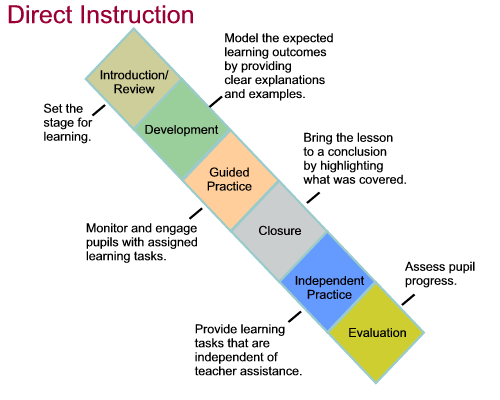
I am a strong visual learner and so I found this is a terrific diagram of the steps that make up a Direct Instruction lesson plan:
http://www.worksheetlibrary.com/teachingtips/imagedirectgif.gif.
The conceptual framework was carefully laid out in the last several weeks of class and related module work. I refer to having learned about DI in such detail as having added a crucial tool to my teacher toolbox. We haven't covered the other instructional strategies in detail yet but I am comfortable in knowing how to recognize when and how to use the DI strategy. (Much like a golfer must know which club to use for whatever shot s/he wants to make!)
This video link to a teacher discussing the details of direct instruction was exceptionally helpful in explaining this process. That link is: http://www.youtube.com/watch?v=Fr3ccG6vmqg.
Since I have had such an intense introduction and several opportunities to have guided and independent practice, I feel so confident in this topic that I will also endeavor today to begin writing my own DI lesson as part of the course's requirements. I am eagerly waiting to begin applying all of this knowledge and experience to my own initial DI lesson plan and then to the many DI lessons that are ahead of me as I begin to teach.
Subscribe to:
Comments (Atom)